Join us and act against climate change! Become a member today.
MEMBER LOG IN
DONATE
Green umbrella Logo
  • What We Do
    • Our Work
    • Our Mission
    • Our Region
    • Our Impact
  • Our Team
  • Our Programs
  • Events
  • Resources
    • Member Directory
    • Green Jobs Board
    • Get Outdoors
    • Reports & Tools
    • Stories & Announcements
  • Get Involved
  • Search

Imagine What’s Possible at the 2023 Midwest Regional Sustainability Summit

April 5, 2023 by Krystal Gallagher

Source: Cincinnati Magazine

Imagine What’s Possible at the 2023 Midwest Regional Sustainability Summit

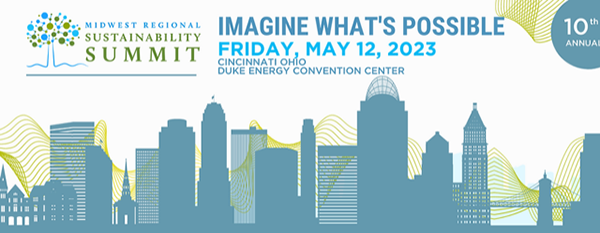
Join hundreds of businesses, nonprofits, governments, and community leaders on Friday, May 12 for the 2023 Midwest Regional Sustainability Summit, hosted by Green Umbrella. This year’s event will be bigger than ever, as it relocates to the Duke Energy Convention Center. “We’re excited to grow the event, include more speakers, and include more creative arts, which can really help balance out the information throughout the day,” says Green Umbrella Event Manager Charlie Gonzalez. “This year, the art show will include paintings, sculptures, and interactive participatory installations and a virtual reality experience.”

Renowned climate strategist, best-selling author, and one of Time magazine’s “Women Who Will Save the World,”  Dr. Katharine Wilkinson will deliver the keynote address. Wilkinson’s work is centered around nurturing climate leadership and building community around solutions, which includes the All We Can Save Project. In addition to the keynote, there will be more than 80 speakers, an exhibitor expo, and an art show featuring 27 artists. “This year’s theme invites us to come together to find active hope and renewed resilience amidst the climate crisis,” adds Gonzalez. “We hope the conference is a spark for connecting, learning, and rising up to secure a just and livable future.”

The Summit will include panel discussions, workshops, and art focused on climate-related issue areas that include:

  • Healthy and Resilient Communities
  • Business and Green, Circular Economy
  • Government and Policy
  • Healthy, High-Performing Infrastructure
  • Active Transportation, Public Transit, and Micromobility
  • Resilient Local Food Systems
  • Climate Justice, Equity, and Inclusion
  • Green Workforce Development
  • Emergency Preparedness

Whether you’re passionate about creating healthier and more resilient neighborhoods, decarbonizing buildings and industries, advancing more sustainable housing and transportation policies, addressing food waste, green workforce development, or climate justice, there are topics to engage everyone to be part of the solution. You’ll walk away feeling empowered and ready to motivate friends, family, and your community to influence change.

The event will feature:

  • 80+ speakers
  • 13 panel discussions
  • Seven interactive workshops
  • Exhibitor expo
  • Art show featuring 27 artists
  • Awards presentation
  • Vegetarian breakfast and lunch
  • Networking reception

Ready to learn more about sustainability and attend the conference?

Visit the Midwest Regional Sustainability Summit website to learn more about the speakers and program and secure your ticket today.

Filed Under: Green Umbrella In The News

Going Green(er): Cincinnati Researchers are Focusing on the Climate Challenges that Intimately Affect Residents

April 5, 2023 by Krystal Gallagher

Source: CityBeat

Going Green(er): Cincinnati Researchers are Focusing on the Climate Challenges that Intimately Affect Residents

This story is featured in CityBeat’s April 5 print edition.

The number of eco-minded businesses – from plant-based delis to secondhand clothing stores to zero-waste refilleries – is growing in Cincinnati. These establishments make it easy (and, for some, fun) for consumers to reduce their carbon footprints.

But what about the region’s sustainability efforts behind closed doors, when direct profit isn’t even in the equation?

A member of the 2030 Districts Network, Cincinnati is one of 23 (and counting) urban cities across North America that have publicly committed to reducing energy consumption, water use and transportation emissions by at least 50% before scientists say it’s too late. According to the United Nations Intergovernmental Panel on Climate Change, 2030 is the year that “unprecedented” action would need to take place to mitigate the worst impacts of climate change.

The Cincinnati district features a group of 49 member organizations that include breweries, museums and universities, all pledging to do their part. The group’s 18 founding members, like Cincinnati’s government and the Cincinnati Zoo, collectively are committing more than 7 million square feet to the district.

So why aren’t Cincinnati’s climate efforts common knowledge?

“I think other parts of the world acknowledge our climate progress more than Cincinnatians do,” Ollie Kroner, director of Cincinnati’s office of environment and sustainability, tells CityBeat.

In a February story in The Guardian, Cincinnati is noted as one of the global cities using Panorama, a national climate action plan tool designed to connect climate action to financing and ultimately to turn ideas into a plausible course of action.

This is just the tip of the iceberg regarding the city’s current efforts, Kroner says.

“We are laser-focused on the climate crisis: how it will impact city government, how it will impact the quality of life of the people that live here and what we’re gonna do about it,” Kroner says.

A new green plan

The latest iteration of the Green Cincinnati Plan is slated to be revealed this spring. Spearheaded by the city’s office of environment and sustainability, it’s an all-encompassing environment plan for the city that has been reimagined and updated every five years since 2008.

“The Green Cincinnati Plan is an action plan. It analyzes where all our carbon emissions come from and then presents a strategy to move toward carbon neutrality by 2050,” Kroner says. “Cincinnati was actually among the early U.S. cities to adopt climate action back in 2008, so we have some practice of this.”

This will be the fourth iteration of the plan, updating on a five-year rhythm.

“As you might imagine, the science keeps improving; politics evolve; the technology we have available to think about continues to progress,” Kroner says, noting that carbon neutrality is a big goal.

According to the Green Cincinnati Plan, committing to carbon neutrality is a goal, but in the fight for climate justice, the environment isn’t the only factor. In partnership with Groundwork Ohio River Valley and Green Umbrella, two esteemed sustainability allies, Cincinnati’s office of environment and sustainability has created a climate equity indicators report that looks at 55 different metrics, helping the office understand how the climate crisis plays out differently from one community to the next. The data collected from this report reveals how some communities are more vulnerable than others.

“We had some funding to actually pay members from that community to come forward and treat them as the subject matter experts on their community and the way that climate is impacting them,” Kroner says. “As our data improves, we are able to zoom in at the city level, zoom in at the neighborhood level, we’re starting to zoom in at the block level – and when you have that kind of data paired with the lived experience of our community members, you can develop real-world practical solutions.”

Kroner says the climate conversation can’t exist without considering those who are affected by it.

“Our steering committee embraced an equity commitment acknowledging inequities [that] government has helped drive historically, addressing those and committing to community voice in the process,” Kroner says.

Leading this steering committee is Cincinnati City Council member Meeka Owens. In kickstarting the Green Cincinnati Plan refresh, Owens says the framework has revolved around sustainability, resilience and equity.

Owens and other officials kicked off the Green Cincinnati Plan’s refresh last May, and 42 community engagement events took place shortly after. Since then, 50 out of Cincinnati’s 52 neighborhoods have held feedback sessions.

“We are doing the work of continually getting this message out there and really focusing on communities that have not been a part of the climate conversation and being really intentional there,” Owens says.

Feedback gathered from the sessions was woven into a draft of a cohesive action plan that the public then reviewed and commented on in January and February. Residents provided more than 600 comments, and Owens and the office of environment and sustainability now are integrating that feedback into a final plan to be unveiled later in April.

Kroner says residents can expect to see a focus on housing in the Green Cincinnati Plan.

“Housing is a loud theme from the community. Why would I care about climate when I’m being evicted next week?” Kroner says. “Designing programs to help reduce utility costs, specifically for people who are renting, is one of our core focuses.”

Kroner says he anticipates a major challenge ahead.

“All of the climate models show that we need to begin to electrify everything. What can we do to help encourage or incentivize the move to electric homes that can be powered by clean renewable energy?” he asks.

The plan also prioritizes transportation.

“About a third of our emissions in Cincinnati come from transportation,” Kroner says. “We’ve just passed this momentous bus study, so we have funding to really make major improvements. What can we do as a city to maximize those [state] dollars and encourage development along transit corridors to help connect communities, help reduce that transportation carbon footprint?”

Kroner says that to accomplish the goal of a greener Cincinnati, climate change must be approached from its effects on the environment and the people living in it. It’s a transition that could take decades, but it’s an opportunity he feels must be maximized now.

“We really feel like this is our moment. We have strong leadership from the mayor-council, we have tremendous community support, and the federal government is making funding available in a way that we’ve never seen before. In some ways, the stars are aligning right now and we feel like we have to make the most of this window of opportunity.”

Cincinnati’s local climate challenges

Photo: Aidan Mahoney
Around one-third of Cincinnati’s emissions come from transportation.

Some experts assert that a human health perspective is important when studying climate change. That’s what Susan Pinney, the director of the University of Cincinnati’s Center for Environmental Genetics, is doing.

“We feel we’re one of the best-kept secrets of Cincinnati,” Pinney tells CityBeat. “The focus is research on the health effects of environmental exposures.”

Cincinnati faces a number of climate challenges, Pinney says, adding that addressing how these issues affect residents’ health is crucial for the researchers at the Center for Environmental Genetics. She says there are two significant weather events exacerbated by climate change on her radar: floods and tornadoes.

“Floods can actually stir up waste deposits along the river, and we especially worry about the Ohio River. Floods can also cause mold in homes, which is a huge health problem,” Pinney says, noting that with the high traction brought in by activities like boating and kayaking, it’s imperative for the Ohio River to be safe.

After experiencing a flooding disaster in her own home in New Richmond, Pinney says she understands first-hand how time-consuming and costly it can be to repair a flooded home and actually rid it of all debris, from the carpet to the walls.

“People who don’t have a whole lot of resources can’t do that. Although the visible mold may be gone, there is mold that is invisible and they’re living with that the rest of their lives and the health effects of that,” Pinney says, adding that her team at UC is working to change that.

With climate trends and their deviations vital in helping inform future decisions at the Center for Environmental Genetics, Pinney notes that the characteristics of tornadoes have begun to shift.

“Data seems to suggest the number of tornadoes has not changed throughout the years, but what has changed is the power of the tornado – the intensity of these tornadoes – and where they’re located,” Pinney says, mentioning tornado touchdowns in irregular locations like Philadelphia in recent years. “What are the airborne exposures that are created by a tornado?” We wanna get into that. A tornado comes around, buildings are demolished and such, houses have asbestos in them, they have metals like lead in the paint, and now it’s in the environment.“

Pinney says she especially is concerned about the rain that follows a tornado.

“Things get saturated. Buildings that have been damaged but are still standing, [they] don’t have a roof and get saturated with rain, and then later on they end up with mold,” Pinney says.

Pinney’s department is able to carry out its mission through its partnership with the National Institute of Environmental Health Science, which provides necessary funding.

”It’s money to improve our capacity to do research, by improving our labs, by improving the expertise of our scientists, by encouraging young faculty, giving them some salary support so they can build their research program.”

Pinney notes the department’s recent work on air pollution.

“We’ve got around the problem of school buses idling while they’re waiting to pick up kids – that’s an example of something that research drove the change and then members of the general public insisted on the change, and so that’s made a substantial change in exposures to kids.”

Pinney says it’s important to her to make Cincinnati’s air and water safer.

“If we’re encouraging people to use our bike trails, to use our walking trails, to run in marathons here, we really have to pay attention to our air quality,“ she says. “In clean air, people can participate more in sports. In clean air, we have more fun.”

Looking to the future

Studying and teaching net-zero energy building at the University of Cincinnati and its College of Design, Architecture, Art, and Planning, Anton Harfmann designs homes to be energy efficient from layout to materials to appliances. To help combat climate change, he combines his architectural engineering background with design.

“Architectural engineering is that middle ground between the very creative side of architecture and the very practical side of engineering and tries to bridge that chasm between ideas and materials,” Harfmann says.

Harfmann studies and teaches net-zero energy building – designing homes to be energy efficient from layout to materials to appliances. According to the U.S. Department of Energy, residential and commercial buildings account for 40% of all U.S. energy consumption. Putting his expertise and passion into practice, Harfmann has turned his 1834 farmhouse into somewhat of a lab, challenging himself with converting it into a net-zero residence while preserving its historic charm.

His architecture and engineering students were able to visit this “lab” to gain hands-on learning, helping them prepare for future net-zero projects and, ultimately, do this work on a much larger scale in the community, Harfmann says.

“Teaching this next generation, I have 50 voices now that are out there clamoring for this kind of stuff and who understand it and are able to then move forward with it on their own, as opposed to me doing one thing right. I can do my house, but that’s only one,” Harfmann says.

Harfmann says there’s a difference between greening up older and newer homes, though.

“The older homes are really difficult to solve this energy equation on,” Harfmann says. “New construction, it’s not as difficult because we have double-pane or triple-pane windows with low emissivity coatings and argon filled in between, and they’re extremely efficient compared to single-pane glass that is 170 years old.”

While building new has its eco advantages, Harfmann acknowledges that not everyone has the resources to do so. In fact, he says that using buildings that already exist in Cincinnati can be the most energy-efficient option, so he was determined to prove that a sustainable old home was possible.

“The idea is to match energy being consumed with energy being produced. If we can bring the energy consumption down as far as we possibly can, then that’s less we have to produce,” Harfmann says. “With the 1834 farmhouse, the problem is there’s only so much you can do in terms of energy consumption before you hit a brick wall – literally, because the walls there are just two or three [layers] with some brick.”

Harfmann says he even found horsehair that was sprinkled into the plaster, which was used to prevent cracking as it expands and contracts.

To make this older home more energy efficient, Harfmann started with LED bulbs and insulated where he could before moving on to the windows.

“There were no storm windows when I moved in, so now suddenly I have two panes of glass and a little bit of air space, which helped tremendously. The windows are your weakest spot,” Harfmann says. “The windows are your weakest spot.” Harfmann says he patched the gaping holes and insulated his windows, reducing the amount of energy flowing through the walls, coming in from the summer heat or escaping the winter.

Harfmann notes while many individuals are interested in making the switch to renewable energy options like solar, they often don’t see it as a good financial investment. To him, that’s a flawed model. While paying off a solar array could take years, Harfmann claims that adopters still save more in a year than they’d be accumulating in interest from money sitting in a savings account.

“If you rethink, when will it pay off and think alternatively, how much interest am I making every year? How much am I not paying in utilities? This is tax-free income, and it’s immune to future energy cost rises,” Harfmann says.

“The incentives that they’ve put out to insulate your home, buy better appliances, get storm windows, get a better water heater, buy an induction stove, buy an electric car are all there,” Harfmann continues, noting that the federal Inflation Reduction Act offers a rebate of up to $14K per household for converting to sustainable energy options.

Back in City Hall, council member Meeka Owens says she believes that no effort is too small in the fight against climate change.

“We’ll start at the micro level because it’s important that we’re all doing our part – are we recycling? Are we avoiding tonnage to the landfill by doing so? Are we composting?” Owens asks.

Over at the office of environment and sustainability, director Oliver Kroner is working on large-scale changes throughout the community and agrees that everyone has an important role in addressing the climate crisis.

“I think a lot of people think corporations are causing climate change and they point at corporations as the responsible party. Corporations definitely play a role, but absolutely individuals do also,” Kroner says.

He urges individuals to consider the environmental impact of their day-to-day lives, from their purchases to their food.

“Those small daily choices do accumulate in a very major way, and I think that we need to own that as individuals and make the right choices, and the organizations we’re a part of will follow suit,” Kroner says. “Behavior is contagious, so leading by example is where we need to be.”

Filed Under: Green Umbrella In The News

Remembering John Bentley

April 4, 2023 by Krystal Gallagher

Source: Cincinnati Enquirer

Remembering John Bentley

Optimistic, engaging, freethinking, creative, lover of nature – those were among the qualities of internationally known landscape architect John Alden Bentley, who passed away peacefully March 26, surrounded by family in his Cincinnati home. Bentley, 82, was born in New York City and grew up the youngest of three boys in Bucks County, Pennsylvania. His father, Alden Cody Bentley, was a pilot who died in 1942 – 15 months after John was born – while testing a B-26 aircraft during World War II. He was raised by his mother, Marion Windisch Bentley, the granddaughter of Conrad Windisch, founder of Windisch-Mulhauser Brewery, Cincinnati’s second biggest brewery in the late 1800s and one of the largest in the U.S. His family’s proximity with American history was extensive and included Buffalo Bill Cody, the first cousin of John’s grandmother, Josephine Cody Bentley. John was a direct descendant of his namesake John Alden, a cooper on the Mayflower, who was among the Plymouth Bay Colony’s most active public servants and, upon his death in 1687, the last surviving signer of the Mayflower Compact.

Bentley was a graduate of the Fay School and Tabor Academy, both in Massachusetts. In 1962, he earned his undergraduate degree in landscape architecture from Penn State, one of the nation’s leading universities in the field, and in 1964, a master’s degree in landscape architecture from the University of Michigan. At the age of 27 with the firm Sasaki Strong Associates, his first significant undertaking was as Project Manager for La Ronde, the extensive entertainment complex that is now the only remaining portion of the Expo ’67 World’s Fair in Montreal. During his nearly 50-year career in Cincinnati, Bentley founded several firms, including Bentley Koepke, Inc., mentored many in his field, and created and executed landscape design for the Cincinnati region’s most prominent and award-winning projects including the Procter & Gamble World Headquarters Gardens & Plaza, Piatt Park, the Hamilton County Courthouse, Great American Ballpark, the Cincinnati Public Library Main Branch and numerous others. He was a fellow with the American Association of Landscape Architects (ASLA), the highest honor in the profession. He was also a former President of the Ohio Chapter of ASLA, former President of the Ohio Landscape Architecture Examining Board, and associate member of the AIA, Cincinnati Chapter. His civic involvements in Cincinnati included being Indian Hill Green Areas consultant for 42 years and a founding board member of Green Umbrella. He was also a member of the Ohio Arts Council founding advisory group, the Cincinnatus Association, the Cincinnati Preservation Association advisory board, the Ohio River Development Commission advisory board, Clean Cincinnati, Cincinnati Beautiful, Urban Forestry Board, Friends of Cincinnati Parks Board, and the Village of Mariemont Architectural Review Board. He was a vestry and session member of Indian Hill Church and a member of both the Civic Garden Center and the Cincinnati Nature Center. As involved as he was in Cincinnati, his most cherished place was the Les Cheneaux Islands in Michigan’s Upper Peninsula, where he was a lifelong summer resident. He could often be found sailing the bays and channels of the 35 islands or puttering aboard his classic Herreshoff sloop. He was a past board member of both the Les Cheneaux Yacht Club and the Les Cheneaux Islands Association, but he was best known for the gardens of his family cottage and the magnificent flowers that adorned its signature blueberry-colored boathouse. In a community of natural enthusiasts, his appreciation of the islands’ beauty was unsurpassed. His final wish, which was not to be, was to survive pancreatic cancer long enough to experience one more June in the islands. Unlike most who preferred July and August, June was his favorite month there because it was the time when life burst forth again in that brief but beautiful northern summer.

After a day spent with his wife and daughters, planting flowers or carving wood or stone into novel creations, he liked nothing more than sitting with family and friends on the elevated, white front porch of his cottage, looking through the treetops to the miles of blue water beyond. He is survived by his devoted wife Helene (nee Sullivan), sons Adam of Toronto, Ontario and Stephen of Kamloops, B.C., daughters Anna (Brendan Bogosian) of Cincinnati, and Rachael, of Boston, three granddaughters, nephew Alden Bentley, nieces Lisa, Alison and Sandra, numerous extended family members and countless friends. He was preceded in death by his parents, brothers Paul and Bill, and by his nephew Christopher Bentley. A Celebration of Life will take place from 1-4 p.m. Friday, May 12 at the Meshewa House at Turner Farm, in Indian Hill, Ohio. Memorials may be sent, in memory of John Alden Bentley, to: The Green Umbrella, P.O. Box 14270, Cincinnati, Ohio, 45250, and to the Civic Garden Center of Greater Cincinnati, 2715 Reading Road, Cincinnati, Ohio, 45206.

Filed Under: Green Umbrella In The News

Green Cincinnati Plan: City unveils playbook for creating more climate resilient, equitable city

April 3, 2023 by Krystal Gallagher

Source: Spectrum News 1

Green Cincinnati Plan: City unveils playbook for creating more climate resilient, equitable city

CINCINNATI — After more than a year of planning, more than three dozen of community meetings and thousands of comments from residents, the city of Cincinnati has unveiled its framework for preparing for climate change over the next five years.


What You Need To Know

  • City Council plans to approve the Green Cincinnati Plan update on April 12
  • The 172-document features goals and strategies for addressing climate change at the local level
  • The document receives an update every five years to reflect changes in science and technology
  • City officials placed an emphasis on equity this year

On Monday, elected officials, environmental agencies and city staff debuted the 2023 Green Cincinnati Plan (GCP) update at the Civic Garden Center on Reading Road. Considered the city’s playbook for climate action, the 172-page document includes 30 goals, 40 strategies, and 130 actions aimed at making Cincinnati more sustainable and resilient.

The last update in 2018 created a path for meeting the city’s previous goals for carbon reduction, she said. That included creating a 100-megawatt array in Highland County, Ohio, to power city-owned buildings.

The city of Cincinnati placed an emphasis on equity in its five-year update to the Green Cincinnati Plan. (Casey Weldon/Spectrum News 1)

But recent science shows more needs to be prepare the city to deal with them, said Council member Meeka Owens, chair of the Climate, Environment, and Infrastructure Committee.

The 2023 GCP plan reasserts the city’s desire to cut local carbon emissions in half by 2030. But for the first time, the city is committing to becoming carbon neutral by 2050.

The City Planning Commission approved the draft plan in mid-March 17. It’ll go before Owens’ committee on April 11. The goal is to have a full vote on City Council to approve it the next day.

“The continuing growing threats of climate change will require all of us to do something differently and demand more from ourselves,” the first-term City Council member said.

Creating a more equitable and resilient city

Climate change is a clear and present danger to all residents, Owens said. But she stressed it won’t affect everyone in the same way. She noted the quality-of-life of those who are Black, brown or live in low-income neighborhoods face greater risk of health issues, or financial hardships related to climate change.

New this year, City Council asked the administration to place an emphasis on climate equity and environmental justice. The team targeted feedback from residents of those “frontline communities” to improve long-term health outcomes and create more resilient neighborhoods overall, Owens said.

Priority actions outlined in the plan include increasing funding for neighborhood gardens and urban agriculture, ensuring all rental housing has at least one room with adequate air conditioning and addressing brownfield properties.

Brownfields are abandoned or under-used properties, such as industrial and commercial facilities, where redevelopment or expansion may be complicated by possible environmental contamination.

City leaders stressed Monday that climate change tends to impact Black, brown and low-income neighborhoods more than others. (Casey Weldon/Spectrum News 1)

The recommendations are broken into eight focus areas: Buildings and Energy, City Operations, Community Activation, Food, Mobility, Natural Environment, Resilience and Climate Adaptation, and Zero Waste.

The document has strategies for things such as adapting to clean energy and improving pedestrian and bike safety. Ollie Kroner, who leads the city’s office of Environment and Sustainability (OES), voiced a desire to take better advantage of the region’s recent public transit levy to make it easier to live in Cincinnati without a car.

Kroner voiced excitement about available federal dollars for those efforts from 2021’s $1 trillion Bipartisan Infrastructure Law. It committed billions of dollars toward clean transportation and other infrastructure projects around the country.

“Bringing in some of that federal money will allow us to invest in neighborhoods by making improvements to homes and businesses here,” he said.

It’s not just federal dollars either, Kroner said. City Council provided $4 million for environmental projects in the last year’s budget. That money is going toward infrastructure and renewable energy needs, but also what he called “frontline” or priority communities experiencing high levels of energy poverty or neighborhoods that don’t have enough tree canopy.

Cincinnati’s “urban heat island” areas — those with a lot of impermeable surfaces like parking lots and large buildings — can get up to 12 degrees warmer than those with more tree canopies and green spaces.

“The structure for deploying those funds is still coming together, but we have more momentum here than we’ve ever had. We really want to make the most of it,” Kroner said.

While most of the talk was about safeguarding against the negative effects of climate change, Peter Blackshaw, CEO of Cintrifuse, referred to the Green Cincinnati Plan to showcase the city as a hub of environmental innovations.

Green and climate technology is a $2.7 trillion business, said Blackshaw, executive director of Cintrifuse. He mentioned several green startups that call the region home — Donovan Energy, Electrada, GoSun, Blue Ocean Solids and 80 Acres Farms. He views the plan as having the power to attract more talent and eco-friendly businesses to Cincinnati.

The Green Cincinnati Plan has the potential to transform the city into a “green lab of the future,” Blackshaw said. He views it as a job creation tool as well.

“This is the signal we want to send to (businesses) as they figure out where to invest the federal dollars to unlock the innovation, we need for jobs inclusivity and more,” he added.

Giving voice to the people of the city

Kroner described the plan is the community’s long-term vision for how Cincinnati can achieve sustainability, equity and resilience.

His team used feedback from nearly 3,800 residents. They collected it during a “robust” outreach campaign that included 42 community meetings over the past nine months. They also allowed the public to comment online.

Joining the collection of elected leaders and project partners on Monday was a group of residents. One of them was Larry Falkin, who led OES for nearly 13 years until 2020.

Falkin worked with then-Mayor Mark Mallory in 2007 to bring a resolution through City Council asking the administration to create the city’s first Cincinnati climate plan. They did a public engagement process throughout the year, leading to the adoption of the first Green Cincinnati Plan in 2008.

Since then, the plan has received an update every five years to reflect changes in climate science and technology, as well as the changing needs of the community. The timeline, he said, provides enough data to set ambitious goals.

Residents attended more than 40 community meetings and provided thousands of recommendations. (Casey Weldon/Spectrum News 1)

“What we’ve seen is that each time we do a five-year plan, by the time you’re two or three years into it, half of the things you set out to do are done and another small slice of the things may have turned out to be impractical,” Falkin added.

Falkin feels one reason people are more engaged this year is people are realizing climate change isn’t “just in California, where it’s burning and, on the coasts, where the hurricanes are,” he said.

As of last April, Cincinnati had experienced nine 100-year rainstorm events in the past decade, according to data from OES. The city had spent more than $150 million to address basement flooding and hill-slide issues related to excessive rainfall in recent years.

“It’s gotten to where that connection has become very visceral, and communities, and it’s inspiring people to want to become more involved,” Falkin said.

The city set a “pretty high bar” in 2018 in terms of public engagement with 30 public meetings and in terms of the ambitiousness of the plan, Falkin said. He was “blown away” by how the group took this update to the next level this time around.

“I didn’t know there was another level, but they reached it,” Falkin said with a laugh.

Owens and Mayor Aftab Pureval praised the community outreach used to get feedback from residents. Much of that was led by Groundwork Ohio River Valley, a Cincinnati-based nonprofit focused on environmental justice.

The organization worked with Green Umbrella, an environmentally minded nonprofit, to support the broadest community engagement effort in the history of the Green Cincinnati Plan.

The kickoff meeting took place on June 1 at the Cincinnati Zoo and Botanical Garden. Since then, events took place in areas around the city. Staff also visited frontline neighborhoods to ensure their viewpoints made their way into the final document.

Thousands of residents contributed feedback to the draft version of the plan. The city plans to continue working with residents over the next five years to ensure the recommendations are being executed. (Casey Weldon/Spectrum News 1)

Residents submitted more that 600 comments on a working version of the draft posted online between January and February. They got only 18 responses during that same period for the 2018 update.

“It’s been a long year,” said Tanner Yess, Groundwork’s co-executive director.

“A lot of comments, a lot of data, a lot of opinions, a lot of feelings, a lot of advocacy work, and really a lot of emotion,” he added, “but now the work begins.”

Groundwork Ohio River Valley is leading the way on Climate Safe Neighborhoods partnership with the city and Green Umbrella. Through that, they’ll work to receive feedback from residents to learn about specific needs there.

“We have the data and know the hard science, but it needs to be paired with the lived experiences of residents,” he said. “They’re the ones experiencing the effects of climate change in their communities every day and have great insights into what can be done to address those things.”

Ashlee Young, chair of the Equity Committee, praised the work of the Green Cincinnati Plan for its work to assemble the update. But she emphasized a lot can happen over the course of five years.

She told residents to continue to talk to leaders at City Hall about what they’re seeing or not seeing in their community. She reminded city leaders of the importance of continuing to be purposeful about their engagement and to “invest in the people and communities most impacted by environmental injustices.”

If not? “Hold them accountable,” she added.

To help with transparency, the city partnered with a Swedish company called ClimateView. The company created a dashboard platform specifically for climate action reporting, to help with accountability efforts, Kroner said.

The dashboard will feature real-time data about local carbon emissions, strategies being used, and GCP milestones.

Cincinnati is the first major city in the United States to use it, Kroner said.

“I will tell you that members of the Green Cincinnati team have poured themselves into this work,” he said. “We experience tremendous pressure to get this right — to meet this moment of urgency and opportunity. But together, I believe we can achieve these goals.”

Filed Under: Green Umbrella In The News

Leaders Introduce Completed 2023 Green Cincinnati Plan

April 3, 2023 by Krystal Gallagher

Source: City of Cincinnati

Leaders Introduce Completed 2023 Green Cincinnati Plan

Today at the Civic Garden Center in Avondale, Mayor Aftab, Councilmembers Meeka Owens and Mark Jeffreys and the Office of Environment & Sustainability introduced the completed 2023 Green Cincinnati Plan for adoption as Cincinnati’s official climate action plan. The Green Cincinnati Plan is a community vision that includes 30 goals, 40 strategies, and 130 priority actions that will lead to a more sustainable, equitable, and resilient Cincinnati. The primary goal of the Plan is to achieve a 50% reduction in carbon emissions by 2030 and 100% carbon neutrality by 2050.

“While the 2018 Plan has guided Cincinnati on a route to meet our previous goals for carbon reduction, the continuing, growing threats of climate change require us to demand more from ourselves and from each other,” said Councilmember Meeka Owens, chair of the Green Cincinnati Steering Committee and Council’s Climate, Environment, and Infrastructure Committee. “Our community showed up and participated in the Green Cincinnati Plan renewal process because they care deeply and share these concerns for our future.”

The Office of Environment and Sustainability, in partnership with Green Umbrella and Groundwork Ohio River Valley, conducted 42 engagement sessions and engaged a total of 3,766 people. This included 157 people at events held specifically for frontline communities.

“If we want to fully reach our potential as a City, then it’s critical that we step up and meet the golden opportunity we have right now.” Said Mayor Aftab Pureval. “To build an economy around clean energy and innovative green jobs, to capture the historic federal funding opportunities for climate action, and to make sure that every community in Cincinnati is resilient and positioned to thrive in the generations to come.”

The recommendations of the GCP are organized across eight focus areas: Buildings & Energy, City Operations, Community Activation, Food, Mobility, Natural Environment, Resilience & Climate Adaptation, and Zero Waste. Across all the focus areas, items that emerged as key community priorities include creating jobs, prioritizing communities, fostering public awareness, and leveraging funding opportunities.

“With the adoption of this year’s update to the Green Cincinnati Plan, we continue to make equity and environmental justice a priority of City Council. From eliminating food deserts in all neighborhoods to adding 4,000 good paying, green jobs, these strategies ensure Cincinnati reaches carbon neutrality by 2050,” said Councilmember Mark Jeffreys.

“Climate tech is a $2.7 trillion opportunity. Our region is home to promising green startups such as Electrada, GoSun, Blue Ocean Solids, Donovan Energy, Intersect Ag, and 80-Acres,” said Pete Blackshaw, CEO of Cintrifuse, the regional catalyst for startups and BigCo innovation. “We have the potential to transform our City and Region into Green ‘Lab of the Future,’ as the US is embarking on an unprecedented tech-based industrial policy – with hundreds of billions in incentives to shift to a green economy – and we have a once-in-a-generation opportunity to capitalize on this opportunity.”

Director Ollie Kroner of the Office of Environment and Sustainability said, “I will tell you that members of the Green Cincinnati team have poured themselves into this work. We experience tremendous pressure to get this right – to meet this moment of urgency and opportunity. But together, I believe we can achieve these goals.”

Filed Under: Green Umbrella In The News

Green Umbrella’s Midwest Regional Sustainability Summit May 12 to feature local art exhibition

April 3, 2023 by Krystal Gallagher

Source: NKY Tribune

Green Umbrella’s Midwest Regional Sustainability Summit May 12 to feature local art exhibition

Green Umbrella’s 10th annual Midwest Regional Sustainability Summit on May 12 at the Duke Energy Convention Center will include an expanded art exhibition. In addition to a full day of programming with 80+ speakers and an exhibitor expo, the conference will feature 27 regional artists whose work aligns with this year’s Summit theme, “Imagine What’s Possible,” which invites us to come together in collective hope and renewed resilience amidst the climate crisis.

The art exhibition, curated by local artists Devan Horton and Sarah Richard, features a variety of mediums including paintings, sculptures, performances, sustainable fashion, as well as interactive and participatory installations. “With such an action-packed day and so much information to take in, I believe the artwork will help attendees process all that information and keep them inspired as they move throughout the day,” said Horton.

One installation will include a virtual reality space where participants will be invited to visualize the proposed on-road bicycle infrastructure transformations in Newport.

“Art can be a transformative tool for community organizing around the climate crisis,” said Richard. “To go beyond seeing this work as just a problem to what positive possibilities there are when we come together, is an inspiring opportunity.”

Tickets to the Summit are available at www.midwestsustainabilitysummit.org. Join leaders from across the Midwest to imagine possibilities that inform, empower, and motivate our actions to create a more vibrant, equitable, and thriving region. The Summit aims to be a spark for connecting, learning together, deepening our resolve, and joyously aid in finding our places in the mighty “we” rising to secure a just and livable future.

Learn more about the Midwest Regional Sustainability Summit, visit www.midwestsustainabilitysummit.org.

Green Umbrella

Filed Under: Green Umbrella In The News

Fort Thomas Forest Conservancy and city to present largest Earth Day celebration in NKY Sunday, April 30

April 1, 2023 by Krystal Gallagher

Source: NKY Tribune

Fort Thomas Forest Conservancy and city to present largest Earth Day celebration in NKY Sunday, April 30

The Fort Thomas Forest Conservancy (FTFC) and the city of Fort Thomas will present the largest Earth Day celebration in Northern Kentucky on Sunday April 30, noon-4 p.m. in Fort Thomas’ Tower Park.

This year’s international theme is Invest in Our Planet and that theme will be evident throughout the park.

Guests will be able to chat with experts to learn about solar power, locally sourced food, area green organizations, and local artists all while enjoying food and drink trucks, live music, as well as a children’s activity zone. They can also pick up free tree saplings for their landscape projects.

Guests are encouraged to bring old or nonfunctioning electronics to recycle with Tri-State Green PC (if it has a plug then they can recycle it) as well as old gym shoes to recycle with Christ Church.

All Northern Kentucky conservancies as well as one of southern Ohio’s largest land trusts will be present to showcase trails and activities that they offer.

Guests can learn about the value of the birds and bees in the area from the NKY Bird Club and the NKY Beekeeper as well as have a friendly encounter with live goats.

And, of course, there will be a live chain saw sculpture event where local artist, Chris Rust, will give new life to trees downed in storms.

In all, there will be approximately 75 vendors and exhibitors covering an array of interests.

The Berry Center and the Blue Marble will sell books geared to all age levels. And area garden clubs will offer tips. And visitors will be able to chat with experts from the University of Kentucky Extension Office, Kentucky Fish and Wildlife, and Kentucky Department of Forestry.

See how many organizations are working toward making NKY a greener and more desirable area to live and work.

Hosting organization Fort Thomas Forest Conservancy, in cooperation with the City of Fort Thomas, has free compost. Visitors can take compost home in their own buckets or even pickup load from the designated spot behind the Natural Start-Pre-school in Tower Park.

Here is a partial list of participants to date:

The Berry Center
KY Department of Fish and Wildlife
KY Department of Forestry
G Solar
Green Umbrella
Ohio River Foundation
Grassroots and Vine
Last Mile Food Rescue
Our Land Organics
Reser Bicycle
Springcreek Farm
Texas Joe Tex-Mex Food truck
West Sixth Beer
Dallas Oak Goat Farm
Live music

Fort Thomas Forest Conservancy

Filed Under: Green Umbrella In The News

Five ways you can be sustainable this spring

March 22, 2023 by Krystal Gallagher

Source: The UC News Record

Five ways you can be sustainable this spring

Springtime is here, bringing new beginnings and fresh starts. People tend to find a spark of motivation as the sun begins to warm the earth again. With the continuing threat of climate change, an outlet for this new motivation can be found in helping the planet. Here are several actions you can take to help. 

Recognize and support

Recognizing the impact of carbon emissions and where they come from is a crucial step to creating a more sustainable environment. The City of Cincinnati’s Office of Environment & Sustainability has a plan known as The Green Cincinnati Plan, intending to reach carbon neutrality by 2050. 

“Voicing community support for what is here is critical,” said Oliver Kroner, the director of the Office of Environment & Sustainability. Showing recognition within your community is one way to promote and support the need for change.

Buy less, eat more

Overconsumption is a major contributor to climate change. A simple way to be more sustainable is by being mindful of how much food you purchase and how much food you waste. So, starting this spring, consider what you’re buying at the grocery and if it is truly needed.

Ditch plastic

Instead of using plastic, find a substitute. Some of the most common uses of plastic include bottled water and plastic shopping bags. Simply substituting bottled water for tap or filtered water in reusable water can aid in the reduction of plastic waste. In addition to creating a more sustainable environment, using a thermal bottle will keep your water cold as the weather begins to warm. Replacing plastic bags with reusable ones can also help reduce the amount of plastic used and wasted.

Alternative transportation

Vehicles are another significant part of carbon emissions. According to the Office of Environment and Sustainability website, “Cincinnati vehicles account for about a third of our carbon emissions.” 

With that said, taking fewer trips in your car is another way you can be sustainable. As the temperature rises this spring, consider walking to the destinations that are close by. In addition, using public transit, carpooling when possible and, for University of Cincinnati (UC) students, hopping on a UC shuttle are other alternatives to driving your car that is very obtainable, especially around UC.

Get involved 

You can volunteer and get involved in several groups and organizations to help promote and practice sustainability this spring. For students at UC, there are several organizations that you can join that revolve around bettering the environment, like Clean up Cincy — where you can volunteer your time to help keep the streets clear of trash. There is also Net Impact UC, where you can be involved in “building a more just and sustainable world,” as it says in its Instagram bio, in many ways. 

Outside of UC, there are other groups in Cincinnati that you can be involved in, as well. One of these groups includes Green Umbrella, a sustainability alliance that offers several volunteer opportunities like working fundraisers, planting species and cleaning up the environment. 

Taking the time to be involved in your communities actions towards climate change is another vital way to be sustainable.

“I think there is a false narrative that it doesn’t matter what we do as individuals,” Kroner said. 

What you do matters, and your choice to practice sustainability is the key to creating the needed change. The start of the spring season is a wonderful time to create new habits and routines. So this spring, help create a healthy community and environment by practicing sustainability.

Filed Under: Green Umbrella In The News

How Cincinnati’s Climate Safe Neighborhoods Partnership promotes climate equity

March 13, 2023 by Krystal Gallagher

Source: Yale Climate Connections

How Cincinnati’s Climate Safe Neighborhoods Partnership promotes climate equity

As the climate warms, Cincinnati, Ohio, is getting hotter and wetter. But some residents suffer more than others from heat and flooding.

Because of historical housing practices that worsened segregation and disinvestment, low-income residents and people of color are more likely to live near roads and factories. These areas often lack trees and green spaces that provide cooling and absorb stormwater.

“So our program is all about taking this history into account and ensuring that there’s some restitution and reparation for past harm, and transformation so that their future can look different than its past,” says Savannah Sullivan of Green Umbrella, Greater Cincinnati’s regional sustainability alliance.

Her group is part of the Climate Safe Neighborhoods Partnership, an initiative facilitating climate advisory groups in eight neighborhoods. These groups of residents draft climate action plans that show where trees, cooling stations, and other solutions are needed.

“And so it’s a way of elevating lived experience and expertise of those who are on the front lines in their neighborhood directly into local planning and project mechanisms,” Sullivan says.

So people are better protected as the climate warms.

Reporting credit: ChavoBart Digital Media

Filed Under: Green Umbrella In The News

Greater Cincinnati bike trail usage increased last year

February 21, 2023 by Krystal Gallagher

Source: Cincinnati Business Courier

Greater Cincinnati bike trail usage increased last year

The number of people using Greater Cincinnati’s bicycle and pedestrian trails grew in 2022, according to Tri-State Trails, an advocacy group for a connected regional trail and bicycle network.

The group has been collecting data on usage since 2017 and found a major spike in usage in 2020 at the beginning of the Covid-19 pandemic as people sought outdoor recreation.

Two usage metrics dropped in 2021, but growth resumed in 2022.

Tri-State Trails uses two measurements – average annual daily traffic and trail miles traveled annually.

In 2022, trail miles traveled was 17.7 million, up from about 17 million in 2021. In 2020, residents and visitors traveled 22.7 million miles on the region’s trails.

It also uses a metric called annual average daily traffic, which was 291 in 2022, up from about 283 in 2021. It was 301 in 2020.

That means on any given day last year, roughly 291 people were on the regional trail network. The number varies greatly depending on the specific trail corridor and time of year. It represents the average usage of all trails monitored by Tri-State Trails throughout the entire calendar year. For example, Wasson Way’s average daily traffic alone was 695.

Wasson Way, which runs between Evanston and Red Bank Road and connects with Mariemont via the Murray Path, helped drive trail growth, with usage increasing 144% from 2021 to 2022. Last year was the first full year of the Wasson Way segment connecting with the path to Mariemont being open, significantly increasing the length of the trail as well as the population within close proximity of it.

“With each new extension of Wasson Way, trail usage continues to trend upward,” Wade Johnston, the executive director of Tri-State Trails, said.

Traffic on the Mill Creek Greenway, which runs along the eponymous waterway from Northside to South Cumminsville, increased 195% from 2021 to 2022. In 2022, after years of delay, the city repaired a broken platform on the trail in Salway Park.

Usage on the Purple People Bridge connecting Newport and downtown Cincinnati increased 27%, while people riding or walking at the Lunken Airport Bike Path, which added a connection to the Little Miami Trail, increased 23%.

A link between unconnected portions of the Great Miami River Trail in Butler County also aided usage of that pathway, which saw a 50% increase in usage between Middletown and Franklin. Overall, the trail’s usage increased 12% in 2022.

MetroParks of Butler County and the city of Monroe have been awarded funds to extend the Great Miami River Trail south from its current end point in Middletown to Monroe’s Bicentennial Commons.

Filed Under: Green Umbrella In The News

Environmental leaders make final push for public feedback as Green Cincinnati Plan

February 3, 2023 by Krystal Gallagher

Source: Spectrum News 1

Environmental leaders make final push for public feedback as Green Cincinnati Plan

CINCINNATI — There’s still time for residents to weigh in on a strategy aimed at combating climate change in Cincinnati and to bolster the environmental resilience of the city’s 52 neighborhoods.


What You Need To Know

  • Residents have until Feb. 8 to provide feedback on the Green Cincinnati Plan
  • The document serves as an environmental guide for Cincinnati lawmakers as they come up with policies and budget plans
  • The document receives an update every five years to reflect changes in science and technology
  • Cincinnati placed an emphasis on equity in this year’s plan

Through Wednesday, Feb. 8, residents can provide feedback on more than three-dozen high-impact strategies listed in the 2023 the Green Cincinnati Plan. The plan, which Cincinnati City Council must vote to approve, serves as a sort of playbook for local policymakers to create laws and develop programs through the lens of environmental sustainability.

So far, more than 4,000 residents from all over the city have contributed recommendations over the course of the past seven-plus months either at a public meeting or an online survey.

A team of city leaders, environmental experts, community partners and residents analyzed and debated each of those recommendations. They then used that input to craft 39 key strategies.

Now, the Green Cincinnati Plan team is giving residents — both new and those who’ve already commented — a chance to weigh in on the recommendations or suggest something they feel is missing.

Participants can choose to submit feedback on either the overall plan or the eight individual focus areas —buildings and energy, natural environment, zero waste, resilience, community activation, mobility, and food.

Dating back to 2008, the Green Cincinnati Plan came about as a way to help the city prepare for climate change. (Casey Weldon/Spectrum News 1)

The feedback period on the draft opened in late January. But Molly Robertshaw, who handles engagement programs for the city’s Office of Environment and Sustainability, described the push over the next few days as a “double-check” to ensure the plan isn’t missing any major community priorities.

“As this plan represents a community vision and plan for climate action, continuing this momentum is imperative,” said Robertshaw, the project’s facilitator. “While the city is coordinating the Green Cincinnati Plan process, the implementation of the final plan will be brought to life by a constellation of champions.”

First created in 2008, the Green Cincinnati Plan receives a refresh every five years to accommodate the city’s changing needs and incorporate the latest scientific data.

The plan serves as a guide for city officials as they consider things such as the ecological effects of new developments, or when they’re looking to establish budget priorities.

Each plan update contains a list of goals and recommendations for improving the climate resiliency and environmental quality.

The last update in 2018 featured 80 recommendations aimed at slashing local carbon emissions by 80% by the year 2050.

Over the last five years, the city has enacted or is near completion of 85% of those goals, according to city data.

During the last five years, Cincinnati has funded a massive solar energy array being constructed on former farmland about 45 miles east of downtown Cincinnati. The plan also prompted the creation of the Cincinnati 2030 District, which got area building owners to commit to cutting their carbon emissions by 30% by 2030.

But new scientific data suggest more needs to be done and much quicker than once projected, city officials told Spectrum News last summer.

For 2023, the primary Green Cincinnati Plan goals are greenhouse gas reductions of 50% emissions by 2030 and carbon neutrality by 2050.

This year’s update process started in June with a kickoff meeting at the Cincinnati Zoo and Botanical Garden. About 300 people — city leaders, environmental organizations, business reps, and community advocates — attended that first meeting, and the numbers only grew from there. 

After that first meeting, the Green Cincinnati Plan team hosted another 41 in-person and virtual meetings. They resulted in more than 3,700 residents engaged from spring through fall 2022. The group received an additional 300 responses to public comment since mid-January, Robertshaw said.

New this year, the Green Cincinnati Plan centered on equity. In this context, that means ensuring people of differing backgrounds receive fair treatment and that resources go to those who need them most, Robertshaw said.

Green Umbrella, part of the Green Cincinnati Plan advisory team, helped create an engagement process based on benchmarks from other cities’ climate plans that included equity-focused actions, according to Ryan Mooney-Bullock, the organization’s executive director.

The city works on the Green Cincinnati Plan with residents and stakeholders, such as the Cincinnati Zoo and Botanical Garden. (Photo courtesy of Cincinnati Zoo and Botanical Garden)

Green Umbrella and Groundwork Ohio River Valley hosted community engagement sessions in neighborhoods considered “highly vulnerable” to the effects of climate change, Mooney-Bullock said. Those neighborhoods include Avondale, Paddock Hills, Carthage, Over-the-Rhine, Camp Washington and West End.

The Green Cincinnati Plan also considered previously completed Climate Safe Neighborhood resilience plans for Lower Price Hill, Bond Hill/Roselawn and the Beekman Corridor, which runs through parts of English Woods, Millvale, North Fairmount, South Fairmount, South Cumminsville.

For the first time, there was an equity committee, chaired by Ashlee Young of Interact for Health. The committee designed a process to engage diverse voices in crafting the recommendations. 

The committee checked back on the work of each of the Green Cincinnati Plan task teams to make sure strategies reflected things such as environmental and social justice, Mooney-Bullock noted.

Robertshaw described the engagement process as “exponentially higher” than in the past. She called the collection of ideas as “stronger” and “more representative of a diversity of priorities,” which she feels is key to making sure they’re acted upon by all involved.

“Our major takeaway is that our leadership and residents care deeply about the climate crisis we are all facing and have valuable ideas on how we can and should take local action,” Robertshaw added. “Undoubtedly, there will be many more key takeaways once we are able to dive into all of the input received.”

She noted, though, that there’s still work to do.

The 2023 Green Cincinnati Plan will go to the city’s Planning Commission in March, and then to City Council for adoption in April.

While this is the last chance for the public to weigh on the crafting of the recommendations before they’re approved, the city and partners are looking to design an ongoing engagement process for implementing the Green Cincinnati Plan, Mooney-Bullock said.

“The aim is to keep the engagement going to ensure residents play a role in the design and implementation of actions in their respective neighborhoods and across the city,” she said.

Filed Under: Green Umbrella In The News

City of Covington moves closer to ending ‘migratory existence,’ picks design team for new city hall

January 27, 2023 by Krystal Gallagher

Source: NKY Tribune

City of Covington moves closer to ending ‘migratory existence,’ picks design team for new city hall

The City of Covington moved one step closer to ending City Hall’s 50-year “migratory existence” and building a permanent facility that better serves its residents and businesses.

On Tuesday, the Board of Commissioners authorized City staff to enter into negotiations with Brandstetter Carroll, Inc. and Elevar Design Group to develop a contract to design a new City building at 620-622 Scott Blvd.

Andrew Wilhoite, the City’s Director of Special Projects, pointed out that the two local firms have more than 50 years of experience in the region and have worked together for the last 10 years, during which they’ve designed nearly 200 public buildings.

The future home of Covington City Hall in the 600 block of Scott Boulevard. (Photo from City of Covington)

“They have extensive experience with civic legacy buildings, including 40 City Halls, over 100 Fire, EMS and Police stations, and 47 courthouses,” Wilhoite said. “It’s not hard to see their thumbprint in the region. They’ve designed the Kenton County Administration Building, the Campbell County Administration Building, Newport City Hall, the Kenton County Jail, and the Delhi Township Town Center.”

Those projects alone total more than $100 million in civic construction, he said.

Noting that the team had provided Covington with a detailed schedule of the project, Wilhoite said “their selection is a statement that the time for talking about a new City Hall is over, it’s time to start doing.”

Once a contract is entered, the City will begin an inclusive design phase which should last through the year. The City hopes to begin construction in early 2024 with a move-in date anticipated in early 2025.”

Over 50 years, Covington’s City Hall has existed in five temporary locations, in essence living a “migratory existence,” Wilhoite said. Ten years ago, the City moved from 638 Madison Ave. to its current location at 20 W. Pike St. to facilitate the development of Hotel Covington in the former Coppin’s Department Store on Madison. As a sign of its temporary intentions, the City signed a five-year lease that it later had to renew.

Despite a retrofit, the building ­– a former J.C. Penney department store – remains inadequate for government functions. It lacks office space, meeting rooms for large groups, technology, a lobby area, and even a lunchroom. Desks are jammed into hallways, closets, and common areas. People who work closely together are physically separated. And citizens who come to pay bills or apply for permits must conduct their business out in the open. Furthermore, the Commission chambers is poorly lit and has terrible acoustics.

“Something so simple as hiring an intern requires a cascading series of decisions to make room,” City Manager Ken Smith said.

It was Mayor Joe Meyer who several years ago put the vision and process for a new City Hall in motion, saying it was time to take “the long view,” planning not for the next decade, but the next century.
In 2019, the City began a lengthy citizen engagement process called “BeSpoke,” which identified the principles that would guide it in developing a new City Hall.

A volunteer board engaged with citizens and others to come up with guiding principles that included:

  • Fostering multiple connected venues for broad civic exchange.
  • Locating the new City Hall at a hub of Covington public life.
  • Providing many reasons to come to City Hall.
  • Building Covington’s Public Square.
  • Being a Center of Design and Culture.

In 2020, the City purchased property on Scott and added to it in late 2022 when the Kenton County Fiscal Court transferred title of a nearby parcel.

Last September, the City issued a request for qualifications (RFQ) for an architect. Wilhoite said 13 firms – local, regional, national, and international – submitted applications.

A committee of City staff, residents, and business owners spent three months carefully vetting the applicants, reviewing each firm’s history with legacy building, work samples, qualifications, lead staff, references, and schedule.

“The citizen members of the Architect Selection Committee truly went above and beyond in lending their time and talent to the City,” Wilhoite said. “Their unique backgrounds, experiences, and voices reflect the city itself and made for a better process and result than we could have ever expected otherwise.”

Ben Brandstetter, President of Brandstetter Carroll, Inc., said both his firm and Elevar Design Group are excited about the opportunity to work with the City to enhance the community and quality of life for Covington residents.

“This project will provide the venue by which City employees can continue to provide excellent customer service to its citizens while also using it as a tool to grow the City economically,” said Brandstetter.

City of Covington

Filed Under: Green Umbrella In The News

  • « Previous Page
  • 1
  • …
  • 6
  • 7
  • 8
  • 9
  • Next Page »
Green umbrella Logo
  • Careers

  • Contact

  • FAQs

stay connected

subscribe to our Newsletters
© 2026 Green Umbrella. All Rights Reserved.
Privacy Policy · Website by Wonderly.