Join us and act against climate change! Become a member today.
MEMBER LOG IN
DONATE
Green umbrella Logo
  • What We Do
    • Our Work
    • Our Mission
    • Our Region
    • Our Impact
  • Our Team
  • Our Programs
  • Events
  • Resources
    • Member Directory
    • Green Jobs Board
    • Get Outdoors
    • Reports & Tools
    • Stories & Announcements
  • Get Involved
  • Search

Project aims to get more Greater Cincinnati governments working on climate change

July 22, 2025 by Krystal Gallagher

Source: WVXU

A new initiative aims to get more local governments in Greater Cincinnati working on issues related to climate change.

Green Umbrella kicked off its 25 Communities Project Tuesday. Over the next year, the nonprofit will provide climate-focused trainings, resources, and technical assistance to communities including Hamilton County, Newport, and Colerain Township.

Executive Director Ryan Mooney-Bullock says by the end of the project, participating governments will be prepared to create climate action or sustainability plans. The documents can provide roadmaps to address everything from hazards like extreme rainfall to strategies to reduce planet-warming greenhouse gas emissions.

“One of the reasons that plans are so important is because it really gives a legislative mandate for action in that community,” Mooney-Bullock said. “It allows them to start assigning staff time, to have budget line items related to that plan, because it’s something that the community has said, ‘this is a priority.’ ”

She says, currently, fewer than 10 local governments in the region have a climate action plan.

“We want to start seeing those numbers increase exponentially,” Mooney-Bullock said.

Green Umbrella also will help participating local governments execute smaller-scale projects that lessen the effects of climate change.

“It can include food-related efforts such as starting a community garden or kickstarting a farmers’ market,” said Van Sullivan, senior director of programs and climate strategy. “It could be a tree-planting. It could be doing some streetscaping to ensure that you are addressing both stormwater concerns on your street as well as walkability and pedestrian safety.”

Though the federal government is cutting funding for some environmental work, Green Umbrella says it hopes the 25 participating communities will be well positioned to apply for resources from private funders now, and, perhaps, the federal government in the future.

The project will continue through August 2026.

Read more:

  • Trump administration cancels another grant for Green Umbrella
  • How Ohioans can use federal clean energy tax credits before they disappear
  • This rare plant at Sharon Woods is being protected during lake reconstruction

Filed Under: Green Umbrella In The News

Which neighborhoods in Northern Kentucky and Cincinnati are most vulnerable to climate change?

July 8, 2025 by Krystal Gallagher

Source: WVXU

In spring 2021, Cincinnatians came together to form “climate advisory groups” through a partnership between Groundwork Ohio River Valley, Green Umbrella and the City of Cincinnati’s Office of Environment and Sustainability. This work was part of the national Climate Safe Neighborhoods initiative led by Groundwork USA. These groups met weekly to discuss how climate change affected their neighborhoods and created climate resilience plans that outlined strategies to address its effects.

In the years since, this work has spread across the river to Northern Kentucky, where researchers engaged residents to come to solutions that could help with increased heat and precipitation levels.

On Cincinnati Edition, we discuss which neighborhoods feel the effects of climate change most, and local answers to how to tackle the issue of climate change.

More information about the Climate Safe Neighborhoods initiative is available on Groundwork Ohio River Valley’s 2025 Greater Cincinnati Dashboard.

Guests:

  • Kelsey Hawkins-Johnson, Climate Safe Neighborhoods director, Groundwork Ohio River Valley
  • Kristy Hopfensperger, professor, Northern Kentucky University
  • Zoe Robles, researcher, Greater Cincinnati Climate Safe Neighborhoods

Ways to listen to this show:

  • Tune in live at noon ET M-F. Call 513-419-7100 or email talk@wvxu.org to have your voice heard on today’s topic.
  • Catch the replay on 91.7 WVXU and 88.5 WMUB at 8 p.m. ET M-F.
  • Listen on-demand. Audio for this segment will be uploaded to this page by 4 p.m. ET., or subscribe to our podcast.

Select music from Blue Dot Sessions (www.sessions.blue).

Filed Under: Green Umbrella In The News

Green Umbrella to host ‘forever chemicals’ documentary in downtown Cincy

July 3, 2025 by Krystal Gallagher

Source: Movers & Makers

A new documentary exposing the global PFAS crisis will make its Southwest Ohio debut July 15 at Cincinnati World Cinema, followed by a discussion with the environmental attorney at the center of the story.

Green Umbrella will host the screening of “How to Poison a Planet” at 719 Race St. in downtown Cincinnati. The award-winning film, featuring actor and activist Mark Ruffalo, reveals how PFAS, sometimes called “forever chemicals,” have contaminated water, soil, and even human bloodstreams around the world.

PFAS – short for per- and polyfluoroalkyl substances – are synthetic chemicals found in products like nonstick cookware, waterproof clothing, and firefighting foam. They don’t break down naturally and have been linked to cancer, immune dysfunction, and reproductive harm, according to the U.S. Environmental Protection Agency.

“How to Poison a Planet” points to corporate misconduct and regulatory failure as key drivers of the widespread contamination.

The evening begins with a reception at 6:30 p.m., followed by the film at 7:00. After the 90-minute screening, Cincinnati-based attorney Rob Bilott will join a panel discussion. A partner at Taft Stettinius & Hollister LLP, Bilott spent more than 20 years building a landmark case against DuPont for PFAS pollution in West Virginia. His story inspired the 2019 film “Dark Waters,” in which Ruffalo portrayed him.

Green Umbrella – Greater Cincinnati’s climate collaborative – works across sectors to build a more sustainable, resilient and equitable region. Taft Law, where Bilott also serves as board member, is sponsoring the event.

Tickets are $25 in advance or $30 at the door and are limited. Cincinnati World Cinema has donated the theater space, and all proceeds will benefit Green Umbrella’s local climate initiatives.

Buy tickets

Filed Under: Green Umbrella In The News

A local group is researching climate migration and what Cincinnati needs to prepare

June 12, 2025 by Krystal Gallagher

Source: WXVU

George Williams has stacks of ephemera from his family’s history in New Orleans. He pulls out thick books of photos, clippings, and pamphlets documenting it all — including the family’s long-running participation in the city’s famous Mardi Gras carnivals.

Williams says he can trace his family’s roots in the city back to the 18th century. But he doesn’t live there anymore. Four years ago, he left and moved to Cincinnati. He had a straightforward reason for leaving his hometown.

“What brought me up here, when you get down to the root of the matter, is climate change,” he says. “I am in my late 50s and I’m an eighth-generation native of the city [of New Orleans]. I’ve spent most of my life there. During that time, firsthand — which, granted, is anecdotal evidence — I’ve watched us go from a storm of the century once every century to a storm of the century once every couple of years.”

He’s not the only one to make the journey. In recent years, people have moved to Cincinnati to escape wildfires in California, hurricanes in New Orleans and Florida, and extreme heat in Arizona.

Just how many isn’t exactly clear — they’re a blip in Census data suggesting more people are actually leaving Cincinnati for other states than are coming here from them. But local environmental groups are studying the phenomenon known as climate migration.

They want to make plans in case more people start coming to Cincinnati because it’s relatively insulated from some of climate change’s most dramatic effects.

A complex issue

Van Sullivan works for Green Umbrella. The regional environmental group is undertaking a major project this summer to understand how people see Cincinnati as a potential destination to escape extreme weather elsewhere and what that could mean for housing, infrastructure, and other local issues.

“We want to get a handle both on awareness of climate migration as an issue but also an understanding of these adjacent issues that touch what we would need to attend to should we become a climate haven,” Sullivan says.

Amy Cotter is a researcher with the Lincoln Institute of Land Policy who studies climate migration. She says exactly how many people are moving to new regions due to climate change is difficult to pin down. Census data can show new influxes of population. But it doesn’t show why people moved. And those decisions are often made based on a variety of factors.

But Cotter says both scholarly research and data from real estate companies suggest a number of people are thinking seriously about the issue as they move. One study by real estate firm Redfin found two-thirds of people moving to a different part of the country factored in climate change. Other studies vary widely, with some saying about 15% of respondents rate it a top concern.

“It’s on peoples’ minds,” Cotter says. “They’re clearly factoring it into their relocation decisions.”

One of many pieces of New Orleans carnival ephemera George Williams has kept from his family’s collection.

Climate change is personal

For Williams, it was a deeply intense and personal choice, in part borne from losing loved ones and prized possessions to hurricanes.

Scientists say climate change isn’t necessarily causing more hurricanes. But it is making the ones that form much more intense. As the Gulf of Mexico heats up, for example, those higher temperatures cause stronger, longer lasting hurricanes that strike land more often and move further inland. There has been a marked increase in the severest hurricanes — ones like Hurricane Katrina, Ida and Helene — in the last couple decades. That’s a big concern for Williams.

He had ridden out hurricanes before, including the infamous Katrina. And he rode out Ida in his house in New Orleans. But something changed in him after that. He remembers watching weather forecasts on a laptop powered by a solar cell because his power wasn’t due to be restored for weeks. They were showing more storms potentially hitting New Orleans in the aftermath of Ida. He knew he couldn’t stay.

“Quite frankly, at that point I broke,” he said. “An overwhelming sense of ‘I’m going to die, my animals are going to die. I can’t do this anymore.’ And that’s what led me up here.”

Why Cincinnati?

Fear of extreme heat, wildfires, or hurricanes might be reasons people leave other regions. But why come to Cincinnati specifically? Experts like Cotter say there are multiple factors.

Jose Lopez-Arenivar grew up in Phoenix and lived there until just a few years ago. He says he remembers being young and dealing with the desert heat as he played with his friends. But there would be rainy times that cooled things down, and temperatures at night were reasonable. That changed as he grew up. Rising heat and longer hot seasons pushed Lopez-Arenivar to his limits. He says rising low temperatures at night put him over the edge.

“Those summers just kept getting longer and longer,” he says. “It just kept getting hotter. It takes a toll on you mentally, physically. As soon as you walk outside, you’re angry.”

By 2022, he and his wife knew they needed to move elsewhere. Both work from home, but his wife’s job relies on being in the same state as the company she works for. That narrowed their choices to other hot places like Texas and Florida — or Ohio.

Lopez-Arenivar began researching. He tracked the weather in various Ohio cities, looked at home prices and cultural amenities. He noted the Great Lakes are relatively close for water access. Weather fluctuates, but generally not in extreme ways seen in other places. Weighing all the factors, he says Cincinnati stuck out.

“A little bit of everything, but it’s very mild in everything,” he says. “So that’s why we ended up choosing Cincinnati.”

The family moved to the city’s eastern suburbs a few years ago.

Family ties

Other recent climate-motivated transplants WVXU talked to said they followed people they knew here. And some said family and friends had followed them here after they moved. Williams has friends who moved to Cincinnati after Hurricane Katrina, influencing his choice to come to the city.

Rose Hemphill moved to Cincinnati from Florida in 2019. She had a laundry list of climate-related worries — flooding, loss of power, extreme heat — that she is glad to have escaped.

“I have lived in three different states in the South, and had to evacuate from every single one of them for hurricanes,” she said. “And I was really, really sick of the heat. People say, ‘You’re crazy, why would you move from Florida to Ohio?’ But I was so done. I was ready to get out.”

Her path out of the South was largely about climate change, she says. But her path to Cincinnati specifically was more about her now-husband. He’s from Cincinnati originally and when Hemphill decided to leave Florida, the Queen City was a natural relocation spot. And she’s not alone. She had family in New Orleans who, like Williams, decided to leave after Hurricane Ida.

“They called us and they were like, ‘Do you like Cincinnati?’ And we were like, ‘Yeah!’ So they moved here six months later. And they’re still here,” Hemphill says.

Likely a small trend — but one that could grow

Williams, Lopez-Arenivar, and Hemphill are just a few of the thousands of people who moved to the region in the last few years, and their stories are anecdotal. Plus, Census data suggests that while Greater Cincinnati gained 20,000 new residents between July 2023 and July 2024, most of them came from other countries. Some of them could have come due to climate change as well — or political instability, lack of resources or other issues.

But the region actually saw a decline in interstate moves like the ones Williams, Hemphill, and Lopez-Arenivar made. Census data suggests roughly 900 more people left for other regions of the United States than came here from them last year.

Climate experts say their stories are still important reminders of the impacts of climate change — and of the need for cities to prepare.

Future issues

Cotter of the Lincoln Institute of Land Policy says increased climate migration could cause a number of issues for cities if trends were to intensify. Among them: strain on housing supply and potential speculation on residential properties by out-of-town investors — meaning, people who buy property with the aim of reselling it for a profit.

“I would suggest that any place that thinks it might be in an advantageous location needs to pay attention to speculation and pay attention to ways it could maybe forestall displacement of its existing population through rent pressures or housing price pressures,” she said.

Sullivan with Green Umbrella says the group’s work this summer will involve surveys, focus groups, and research about what Cincinnati and surrounding municipalities can do to prepare for climate change and people seeking to escape its effects in other parts of the country.

“Climate migration is one of many factors that shapes our region,” Sullivan says. “And so we are dedicating a significant portion of our work this year to A, better understanding this issue; B, figuring out what are some of the strategy options for our communities are; and C, working with our communities to implement them.”

Cotter says that work is vital.

“Anticipating and putting in place resilience measures will accrue benefits to longstanding residents as well by helping them withstand climate change,” she said. “At the same time, you can plan ahead for what you will do if an influx of population comes.”

Williams says he’s grown quite fond of Cincinnati. Leafing through his books of family lore, he says he still loves New Orleans and misses it often. But he doesn’t see himself ever going back.

“I seriously doubt it,” he says. “I don’t think I could make it through a contemporary hurricane season again with the PTSD and such. If the storm didn’t kill me, my chances of surviving due to my mental state afterward would be slim to none.”

Filed Under: Green Umbrella In The News

Sustainability Summit offers hope, opportunities amid climate challenges

June 10, 2025 by Krystal Gallagher

Source: Movers & Makers

As climate impacts intensify – with more frequent extreme weather, environmental stress and uncertainty – communities across the United States face mounting challenges. Funding cuts, political shifts and social complexities compound the strain.

For Ryan Mooney-Bullock, executive director of Green Umbrella, the Tristate’s regional climate collaborative, this year has been especially difficult. “The past five months have been harrowing for folks working in environmental justice, climate action and conservation,” she said, noting that governments and groups like hers have seen grants frozen or cut without explanation.

“They have lost critical staff capacity with the firing of AmeriCorps volunteers. They face more demands amid federal instability,” Mooney-Bullock added. “But they understand that now, more than ever, they need to be connected to and learning from others who are leading at the local level.”

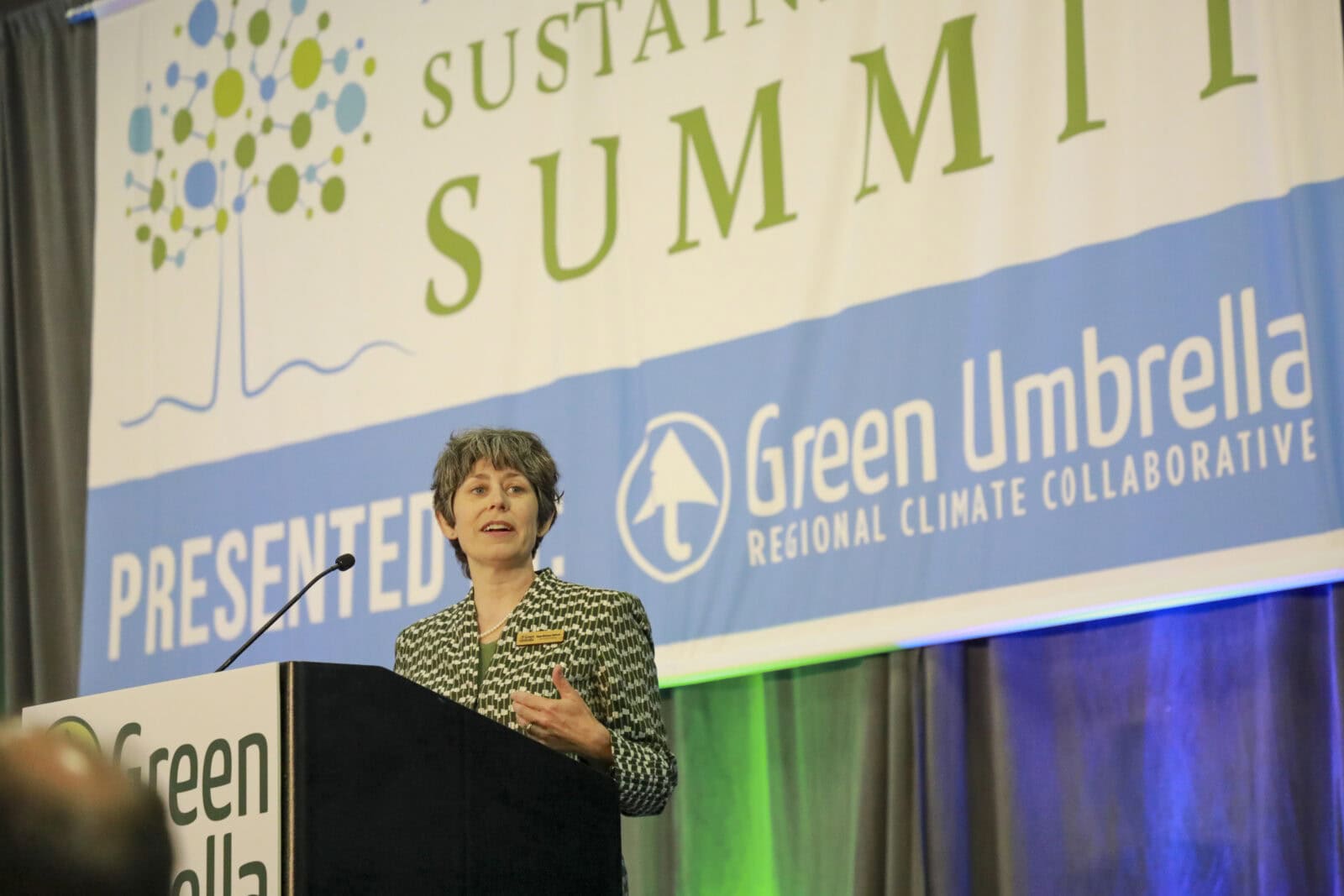
Ryan Mooney-Bullock addresses the crowd at Sharonville Convention Center. (Photo by Caitlin Sparks)

Amid those challenges, Green Umbrella again hosted its Midwest Regional Sustainability Summit to create a space for diverse voices to connect, share solutions and build momentum for a more resilient future.

In its 12th year, the summit drew hundreds of scientists, activists, artists, business leaders, students and policymakers from across the region. This year’s daylong conference in Sharonville featured 95 speakers, 46 exhibitors and 40 research displays. More than 600 people attended.

“It was inspiring to share the day with 600 others continuing this work, even when the path forward feels obstructed,” Mooney-Bullock said.

Platform for collaboration

In recent years, the summit has expanded beyond panels to include art shows, poster sessions and performances, reflecting the broad, creative nature of sustainability work. The event also honored regional innovators with awards recognizing significant contributions.

“This summit isn’t just an event – it’s a catalyst for collaboration and collective action,” Mooney-Bullock said. “It brings together people from all sectors and backgrounds, creating a powerful space where stories inspire solutions and partnerships drive change.”

This year’s theme, “Sustainable Stories,” highlighted resilience and innovation, emphasizing the need to listen to diverse voices – especially Indigenous communities with generations of ecological knowledge.

The audience included participants from various backgrounds and perspectives, with notable representation from Indigenous people. 

Several Indigenous leaders joined panels, and keynote speaker Lyla June Johnston – an Indigenous musician, scholar and community organizer of Diné (Navajo), Tsétsêhéstâhese (Cheyenne) and European descent – addressed the crowd. Johnston said she hoped to learn from the local Myaamia Nation.

“Events like the summit are important because they help us garden the mind,” Johnston said. “Our thoughts shape our reality, and when we cultivate our thinking – rooting it in generosity, humility, compassion and the intelligence to care for the Earth, we can go out into the world and create change.”

“I hope that they take away that Indigenous nations possess a wealth of ecological sciences that could truly benefit the sustainability movement today,” she continued. “It’s important to honor Indigenous sciences, to learn from them, and hopefully to integrate them into our future solutions.”

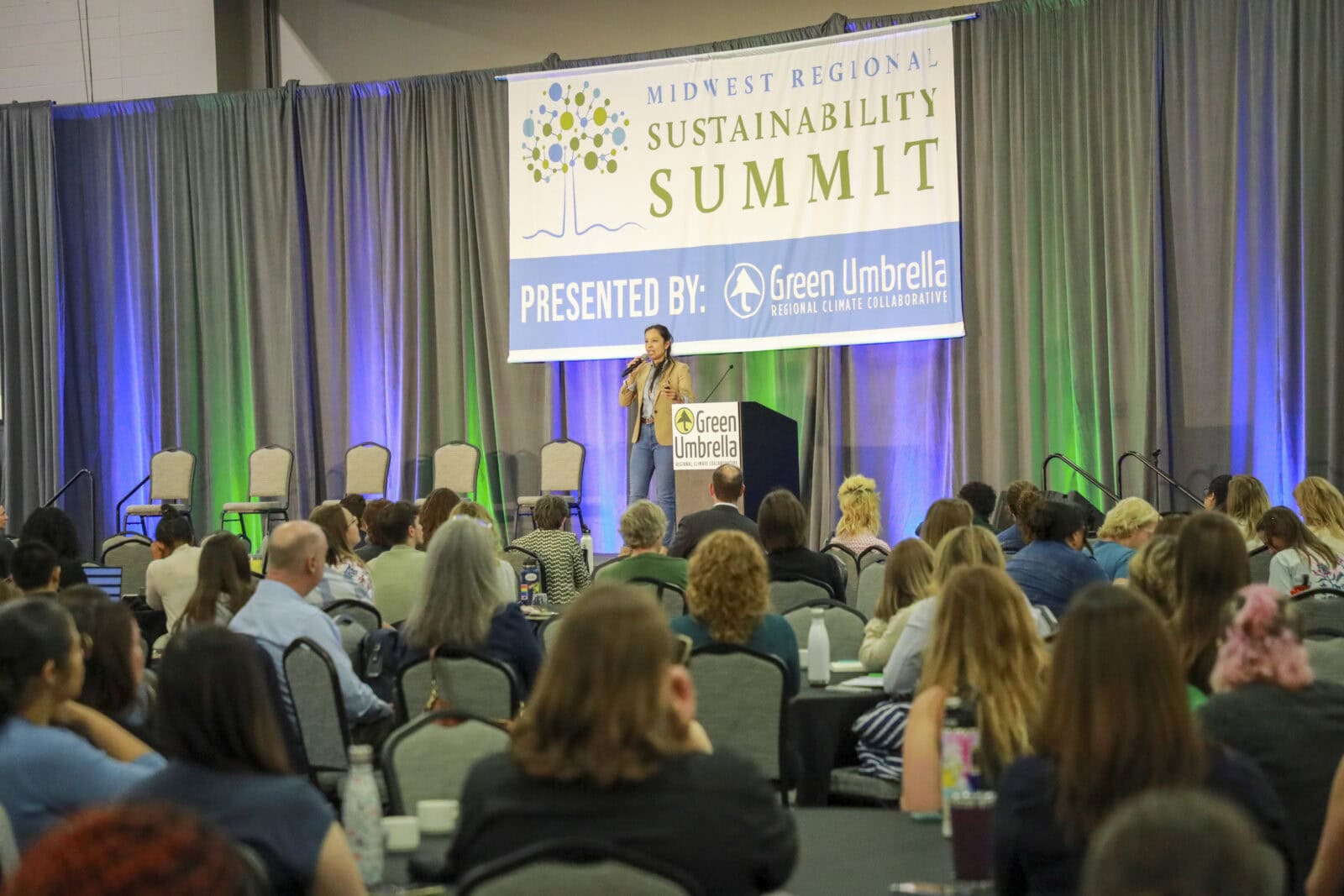
Keynote Speaker Lyla June Johnston (Photo by Caitlin Sparks)

Johnston said sustainability means participating in ecosystems, not conquering them. That shift, she added, presents both a challenge and an opportunity.

The message resonated across generations. Adair McWilliams, a Ph.D. student at the University of Cincinnati, attended with students studying heat-related health impacts in older adults. They found the keynote “really inspirational,” especially its mix of Indigenous knowledge, history and optimism.

“It was informative about Indigenous practices and the history of agriculture and sustainability, but also really hopeful,” McWilliams said. “There’s always moments where we maybe regress or something goes wrong … but we always manage to persevere.”

One of those students was Jessea James, a summer researcher at UC’s Climate and Health Department. James appreciated how ancient practices connected to modern challenges. She also drew inspiration from a session on climate fiction, which gave her “new ideas on how storytelling can drive awareness and action.” 

James plans to apply climate-smart ideas in her writing and studies in environmental law.

“For me as a young individual … it’s very important for people our age to know what’s going on in this country and in our generation,” she said.

Medical student Grace Roudebush focused on how climate impacts children. The future pediatrician said the summit helped her think more broadly about how her work could contribute to those efforts.

“It was interesting to hear how I, even just as a consumer, can make more sustainable choices,” Roudebush said. “So that was something that I know I can take back to my friends and family.”

Businesses, policymakers on common ground

The summit also spotlighted the role of business and policy in climate solutions, with local innovation on display, from textile sustainability to solar energy.

Maggie Herms and Lauren Thomas of Interface, a national flooring company, were struck by discussions on textile waste.

Reflecting on the keynote, Herms said, “Oh my gosh, the whole use of fire to restore soil … she mentioned how the bird rolls around in the ash because of the carbon it contains. It was just kind of like a full circle moment for us.”

After the speech, she began thinking about ways to collaborate with local nonprofit Sew Valley to educate local designers on alternatives to fast fashion, like mending or swapping clothes.

“Textiles are not recycled, only 1% are, we learned,” she said.

Christian Koch, Midwest policy manager for a sustainability nonprofit, spoke on the Ohio Business Energy Partnership and shared insights from his work with the Ohio Business Energy Coalition.

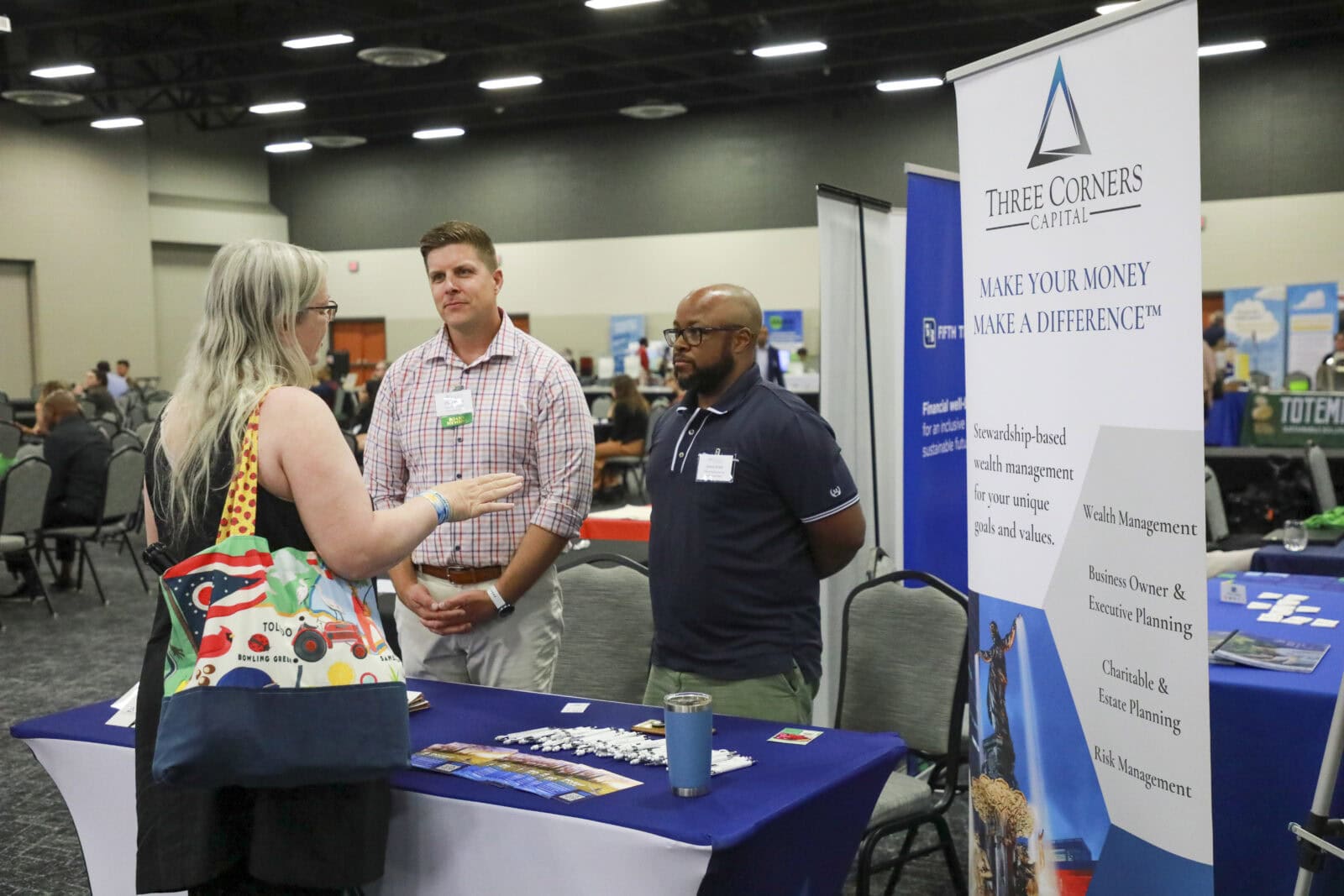
Exhibitors Chris Flores and Jason Jones from Three Corners Capital speak with an attendee. (Photo by Caitlin Sparks)

“I hope attendees took away the idea or understanding that businesses are still committed to sustainability and climate action – that they’re paying close attention to what’s happening in Ohio and across the Midwest,” Koch said.

He emphasized the need for cross-sector collaboration and said he wants to build stronger partnerships, especially with those working in environmental justice.

“We need to find opportunities, identify common ground, capitalize on those opportunities, and work together,” Koch said. “We all have more in common than we think.”

From momentum to action

Despite the scale of climate threats, the summit offered a hopeful glimpse into grassroots innovation. Jacob Schwemien, a self-described concerned citizen, praised local solar initiatives and education efforts from organizations like Hamilton County ReSource, which promotes waste reduction and recycling.

“It’s really great to see the passion of all of these local leaders to attack those problems and improve the world around them,” he said. “Especially in a time when some of that work is either not well funded or politically challenging.”

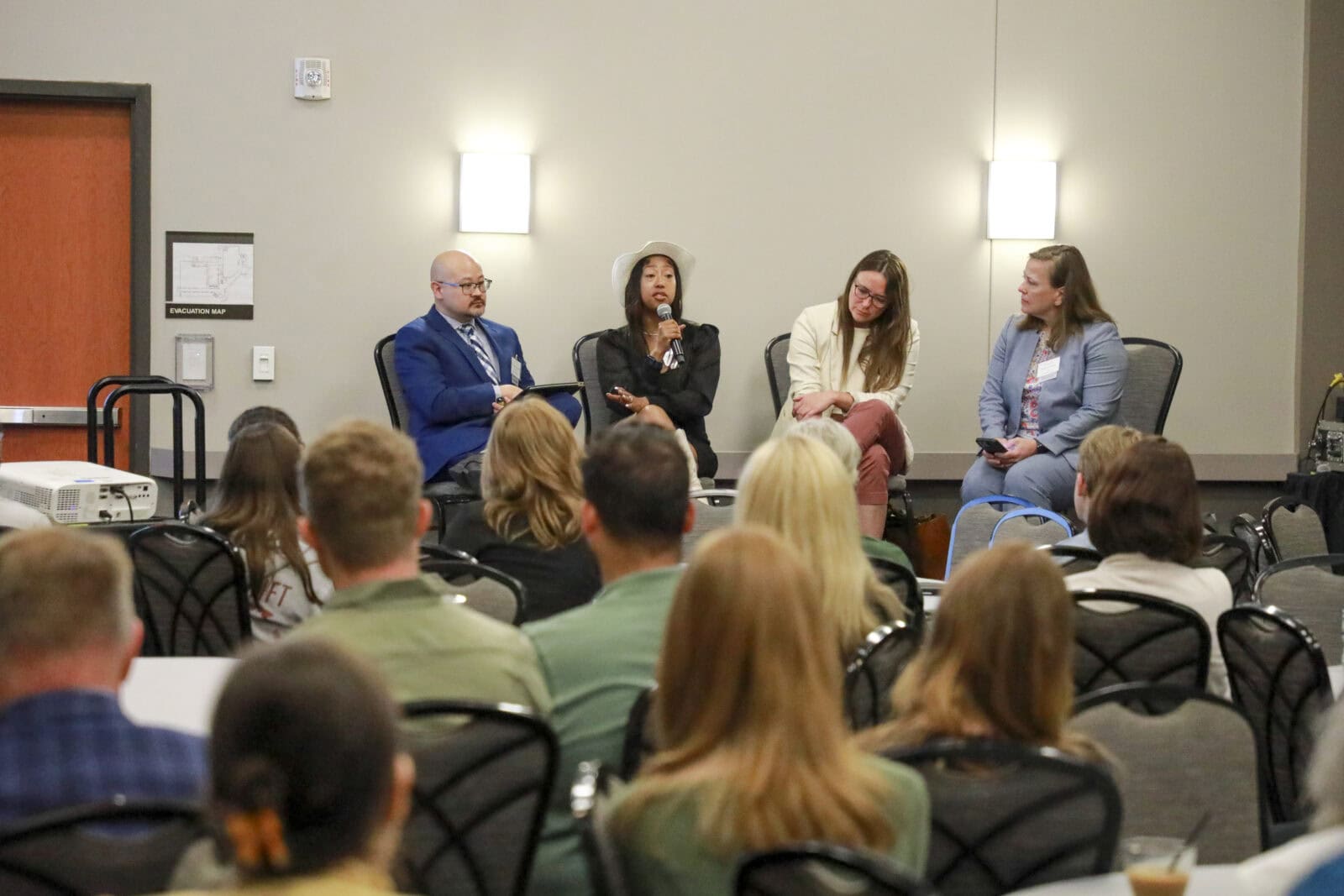
Thanapat Vichitchot, Teneah Chambers, Renee Timberlake and Rebecca Kusner present a breakout session. (Photo by Caitlin Sparks)

Green Umbrella’s Climate Action Fellows and partners shared updates on local plans and projects. The organization will also launch a 25-Communities cohort this summer to expand local government leadership on climate issues.

Mooney-Bullock called the initiative a way to “move beyond conversation” toward “concrete local leadership and climate resilience.”

“We’re building a network of empowered communities ready to face climate impacts head-on,” she said. “And as we welcome new residents displaced by climate change, we have the chance to redefine what it means to be a vibrant, inclusive region.”

Filed Under: Green Umbrella In The News

Art, performance and podcast: Green Umbrella’s annual Midwest Regional Sustainability Summit features the creative side of climate action

May 28, 2025 by Krystal Gallagher

Source: Highland County Press

By Green Umbrella, Press Release

Green Umbrella’s 12th annual Midwest Regional Sustainability Summit on June 5 at the Sharonville Convention Center will feature a live podcast recording, a performance showcase and an art exhibition with local artists.

“Creative expression has the power to ignite change in ways facts alone cannot. By weaving art, performance, and storytelling into the Summit, we invite attendees to see the climate crisis through new eyes — and to imagine bold, hopeful solutions. The arts don’t just reflect the world we live in—they help shape the world we want to build,” says Charlie Gonzalez, Green Umbrella’s Corporate Engagement & Events Manager, who leads the conference planning.

Hosts from the Green Champions Podcast will record an episode of their podcast while moderating a panel titled “Change in Columbus: Key Players in Waste Diversion”. In addition to the live podcast recording, Green Champions Podcast is releasing a 10-episode mini-series featuring a variety of Summit speakers in the weeks leading up to the June 5 event.

The performance showcase will include mezzo soprano Quinn Patrick Ankrum performing four short songs from No One Saves the Earth from Us but Us; Padma Chebrolu and the Cultural Centre of India performing Passage of the River: Dances of India, which blends environmental storytelling with Bollywood dancing; and a Summermusik string quartet performing Jerod Tate’s Pisachi (Reveal).

The art exhibition will feature local artists sharing paintings, sculptures, interactive installations, and more that explore humanity, earth and climate. The pieces will be displayed throughout the Summit.

As the largest sustainability conference in the Midwest, the Summit brings 650 professional and community leaders to the Cincinnati region for a full day of inspiring programming, with 100 speakers, exhibitors, an art show, and live performances. Discussions and workshops will span topics that include green workforce development, corporate sustainability, clean energy, and environmental justice.

You can learn more and register at www.midwestsustainabilitysummit.org.

Filed Under: Green Umbrella In The News

Greater Cincinnati named a Regional Center of Expertise in Education for Sustainable Development

May 28, 2025 by Krystal Gallagher

Source: The Center for Public Engagement with Science at the University of Cincinnati

The Greater Cincinnati region has officially been recognized as a Regional Center of Expertise (RCE GC) in Education for Sustainable Development (ESD) by the United Nations University Institute for the Advanced Study of Sustainability. RCE GC now joins a global network of over 170 regions across the world, and just the 12th in the United States, recognized for their ESD efforts. 

An RCE is a local network of existing formal, non-formal, and informal organizations that facilitate learning towards sustainable development in local and regional communities. An RCE involves school teachers, professors at higher education institutions, environmental NGOs, scientists, researchers, museums, zoos, botanical gardens, local government officials, representatives of local enterprises, volunteers, media, civic associations or individuals who work in the spheres of sustainable development such as economic growth, social development, and environmental protection, students and learners at all levels.

The goals of a RCE network are to:

  1. Re-orient education towards Sustainable Development, tailoring ESD curriculum to address issues and local context of the community in which they operate.
  2. Deliver trainers’ training programs and develop methodologies and learning materials for them; and
  3. Lead advocacy and awareness-raising efforts in the public about the importance of educators and the essential role of ESD in achieving a sustainable future.

A multi-institutional effort to craft and submit the application for Greater Cincinnati’s RCE recognition was led by UC Center for Public Engagement with Science (PEWS) Faculty Affiliate Dr. Andrew Bernier, an instructor of STEM and Sustainability Education in the UC School of Education and Manager of Education for Cincinnati Parks. With the support of PEWS, Green Umbrella, Cincinnati Public Schools, and the UC College of Education, Criminal Justice, Human Services, and Information Technology (CECH-IT) Office of Innovations & Community Partnerships, over a dozen individuals lent their time and insights into crafting and reviewing the application.

The application process started with informational meetings in Spring of 2023, with writing commencing in Fall of 2023 and submission in September of 2024. The application highlighted the work that local partners are already facilitating for ESD outcomes along with projects and plans to amplify inter-organizational collaborations. 35 entities across all sectors submitted signed letters of committed support to ensuring the establishment of RCE GC and continuing the work of their respective ESD efforts, including the City of Cincinnati, the University of Cincinnati, Xavier University, Miami University, Rumpke, World Affairs Council, GroundWork ORV, MadTree Brewing, and more. 

The University of Cincinnati will serve as the secretariat organization for RCE GC to the UNU-IAS, and will be facilitated as a shared initiative between PEWS, CECH-IT, advisory boards comprised of local partners, and Cincinnati Parks, the latter of whom will physically host RCE GC at the Bettman Center for Natural Resources. RCE GC will also work in tandem in the newly established Cincinnati Inner Development Goals (IDG) to align ESD efforts with transformational skill development for sustainable outcomes.

RCE GC is still building their digital presence and hopes to come “online” by the Fall of 2025. For more information about the RCE network, visit the Homepage – RCE Americas Network. You can also easily peruse a clear summary of the RCE Network history and function by visiting the Regional Centres of Expertise – Wikipedia page.

Filed Under: Green Umbrella In The News

Trump administration cancels another grant for Green Umbrella

May 13, 2025 by Krystal Gallagher

Source: WVXU

A project working to reduce energy costs for people living in low-income housing is on hold after the federal government cancelled the grant funding it.

In 2023, Green Umbrella received a $1.1 million award from the Environmental Protection Agency to study energy efficiency and air quality in affordable housing units through a partnership with Over-the-Rhine Community Housing and the city of Cincinnati.

Executive Director Ryan Mooney-Bullock says the initiative also included installing energy-saving technology, like insulation, electric stoves and heat pumps, in about 35 homes.

Now, that work is on pause. Green Umbrella learned last week its grant had been terminated because it is “no longer in alignment with the EPA’s priorities.”

“The loss of these funds means that we have to stop work on projects that were really designed to benefit community members that have been historically underserved, and it’s also preventing us from completing a research study that could then be used to inform how this type of energy efficiency work is rolled out in communities across the country,” Mooney-Bullock said.

She says Green Umbrella was about to make a major purchase of heat pumps when they learned about the grant termination.

“It came at a really bad time in the sense that we were about to do a ton of implementation that is really going to benefit the residents living in these buildings and their nonprofit landlord Over-the-Rhine Community Housing that is managing these buildings,” Mooney-Bullock said.

The Cincinnati-based nonprofit is not the only organization seeing its funding cancelled. The Trump administration is clawing back tens of millions of dollars for environmental research across the country, according to The New York Times.

Green Umbrella is looking for ways to continue the data collection that is already underway. It’s working on the study with three research partners: Indiana University, Carnegie Mellon University and the University of Pennsylvania.

“We have a group of residents who are participating in this and are helping us collect data, and we don’t want to just drop the ball on them,” Mooney-Bullock said.

The nonprofit also is disputing the grant termination with the EPA and seeking final reimbursements. Mooney-Bullock says she doesn’t know how long it will take to get that money back since the payment system no longer shows the grant.

To keep the project moving forward, Green Umbrella is looking to community members and businesses for support.

Loss of two grants is ‘very destabilizing’

This is the second grant Green Umbrella has lost since Trump took office.

The first was a $500,000 EPA grant helping Greater Cincinnati community members address environmental risks in their neighborhoods.

“It is very destabilizing for a nonprofit to have significant funding pulled out at the last minute or while projects are underway,” Mooney-Bullock said.

She says the organization is not currently in a financial position where it needs to lay people off or make staffing changes.

“That is certainly something that is a concern if grants continue to get frozen and we’re not able to raise the support we need from our local partners,” Mooney-Bullock said.

She says Green Umbrella has started to see an increase in community support.

Filed Under: Green Umbrella In The News

Notables in Wellness: Cynthia Walters

April 23, 2025 by Krystal Gallagher

Source: Movers & Makers, (May 2025 print edition, page 24)

Cynthia Walters is the Green Schoolyards manager for Green Umbrella and is notable for advocating for student health and wellness through outdoor learning spaces and education programs. She recently led development of the Local School Wellness Policy Toolkit, a roadmap for school districts nationwide to customize wellness plans for the needs of the school community. She launched the region’s first Green Schoolyards Summit, showcasing community collaboration to provide equitable access to environmental educational resources. Walters was instrumental in the passage of the Children’s Outdoor Bill of Rights for the City of Cincinnati, which guarantees that every child in the city has accessible pathways to experience and interact with nature. Walters loves spending time with her family, traveling, and cheering for Ohio State. She always wears colorful pants, bright yellow or flecked with flowers. The back of her laptop is covered with with stickers that say things like “I <3 Compost” and “Outdoors for All.”

Filed Under: Green Umbrella In The News

Learn How Stories Inspire and Shape Our Future at the 2025 Midwest Sustainability Summit

April 22, 2025 by Krystal Gallagher

Source: Cincinnati Magazine

Join hundreds of business, nonprofit, government, and community leaders at the Sharonville Convention Center on Thursday, June 5, for the 12th annual Midwest Regional Sustainability Summit, hosted by Green Umbrella. This year’s Summit will explore the power of Sustainable Stories and their role in shaping the future, with 100 sustainability leaders from across the Midwest sharing stories of their impact and successful partnerships. The conference serves as a spark to make new connections and celebrate climate solutions that secure a more resilient, equitable, and thriving future!

This year’s keynote speaker is Dr. Lyla June Johnston, an Indigenous scholar, author, musician, and community organizer. Her multi-genre presentation style has engaged audiences across the globe towards personal, collective, and ecological healing. In the lunchtime plenary session, she will be joined by Erika Street Hopman (ChavoBart Digital Media), Tory Stephens (Grist), and Becca Costello (Cincinnati Public Radio) to share innovative initiatives that amplify climate stories and tangible solutions. They’ll share insights into crafting narratives that resonate with diverse audiences, bridge divides, and inspire individual and collective action.

In addition to a full day of panel discussions and workshops, the event will feature an exhibitor expo, poster session, art show, and live performances. “It’s an incredibly diverse event, with something for everyone,” says Green Umbrella’s Corporate Engagement & Events Manager, Charlie Gonzalez, who leads the conference planning.

This year’s Summit offers opportunities to take action among topics you’re passionate about, whether that’s creating healthier communities or joining the fight for climate justice. Every topic is designed to inspire and empower attendees to make a difference in their community. Topics covered throughout the Summit include:

  • Healthy & Resilient Communities
  • Business & Circular economy
  • Government & Policy
  • Food Systems
  • Buildings & Energy
  • Climate Justice
  • Green Workforce Development
  • Emergency Preparedness

Ready to learn more about sustainability and attend the conference?

Visit the Midwest Regional Sustainability Summit’s website to learn more about the speakers and program and to register for the 2025 event.

Filed Under: Green Umbrella In The News

Our power, our planet: Increasing the number of people entering careers in sustainability sectors

April 22, 2025 by Krystal Gallagher

Source: Soapbox Media

Greater Cincinnati Earth Day Free Festival takes place Saturday, April 26 from 12-5 p.m. at Summit Park in Blue Ash. This year’s theme celebrates “Our Power, Our Planet.” The festival will feature over one hundred Earth Friendly exhibitors with something for the entire family. New this year is a career fair that the organizers  believe is a critical component of the day’s festivities to bring awareness to the many areas of green jobs available today. 

The Greater Cincinnati Earth Coalition, in partnership with Duke Energy, is proud to announce the launch of the Environmental Career Path Program at this year’s festival. The aim is to inspire and empower students of all ages to explore careers in environmental fields as well as in construction trades and professions, addressing the growing demand for skilled professionals in the Green Jobs sector.

Through education and certifications, the goal is to increase the number of people entering careers in the sustainability sectors. Students will have the opportunity to meet representatives from leading environmental organizations, green tech companies and educational organizations. Hands-on activities showcase renewable energy, sustainable building and conservation careers. Green Jobs exist in solar installation and environmental science as well as in green construction trades. The Environmental Career Path Program will expose prospective individuals to consider both vocational pathways and college.

Chuck Lohre and the Greater Cincinnati Environmental Educators co-host the career fair with Ohio River Valley Water Sanitation Commission (ORSANCO), the Foundation for Ohio River Education (F.O.R.E.), Green Umbrella, and the City of Cincinnati Office of Environment and Sustainability. Each organization contributes to creating a cleaner, healthier environment in the Greater Cincinnati area.

Both ORSANCO and F.O.R.E. work toward improving the quality of water in the Ohio River basin by ensuring the river is a resource for drinking water, industrial supplies and recreational purposes. The importance of education empowers communities to value and protect their watersheds and become stewards through firsthand programs. Green Umbrella advocates for systemic change with a goal to empower everyone in our region to act and make a difference.  

The City of Cincinnati Green Cincinnati Plan (GCP) has helped establish Cincinnati as a national leader in sustainability and an attractive destination for businesses and individuals. Created in 2023, the plan focuses on buildings and energy, city operations, community activation, food, mobility, natural environment, resilience, climate adaptation and zero waste. The goal is sustainability, equity, and resilience.

Crucial to Cincinnati’s plan is the promotion of Green Job Pathways. They offer resources for employers looking to fill positions. According to the Cincinnati USA Regional Chamber there are approximately two jobs for every one person in our region. Howard Miller,  Environmental Manager for the City Manager’s Office of Environment and Sustainability (OES), would like to attract not only potential employees for the city, but to educate individuals on opportunities in the private sector as well. At the Career Fair he hopes to enlighten students as to how processes could work and what types of trainings are available.

Thanapat Vichitchot of Bridge Builder works with the City of Cincinnati to raise awareness of green jobs and green career opportunities. Through education and training partners he is helping to form a formal green workforce landscape by partnering with the city, Cincinnati Regional Chamber. Thanapat hopes to attract all individuals curious about the possibility of working in such fields as reducing carbon emissions as well as the critical building industry with labor force and engineering professionals.

Summit Park, located in Blue Ash, playground and nature play area.

The day at the Greater Cincinnati Earth Day Festival has something for everyone. Children can visit a farm animal petting zoo. There are opportunities to inspect, and even test drive, electric vehicles at the electric car show. Live music is provided by groups such as School of Rock, Immanuel School of Music, and the Northern Cincinnati Youth Orchestra. Vegan food selections will be available, as well as MadTree Brewing craft beer.

This year, as in years past, there will be a fashion show solely made up of costumes and everyday wear from local thrift stores. Everyone is invited to show off their creativity and ability to find that gem of a piece of clothing, whether you are under the age of 18, in college, or an adult who loves a good thrift find, the “Thrifty Threads” fashion show is the place to shine. Along those same lines a recycled costume contest will also take place.

Join the fun and education. You will be glad you attended on so many levels.

What: Greater Cincinnati Earth Day Festival
Where: Summit Park, 4335 Glendale Milford Road, Blue Ash, OH 45242
Date: Saturday, April 26, 2025
Time: Noon – 5 p.m.
RSVP: This is a free event for the entire family. No tickets are necessary.
For directions, parking and more information, visit: Greater Cincinnati Earth Day website.

Filed Under: Green Umbrella In The News

UC celebrates Earth Day with greener, bolder moves

April 18, 2025 by Krystal Gallagher

Source: UC News

At the University of Cincinnati, Earth Day isn’t just a moment on the calendar — it’s a mindset.
From bioswales to bike shares, from faculty-led public science initiatives to community hikes,
UC is digging deep into sustainability, quite literally reshaping the campus landscape.

This year, UC’s Earth Day celebrations honor a growing portfolio of eco-conscious achievements that stretch across the main and regional campuses. In a university-wide effort that bridges environmental science, design and community action, Bearcats are proving that green isn’t just a color — it’s a culture.

Where invasive insects once left a hillside bare near Langsam Library, a new grove of 19 trees now stands tall, planted by student volunteers as part of a campuswide tree restoration effort. This project, completed in March, transforms the site of once-decimated ash trees into a living example of urban resilience. New ground cover plantings, selected to absorb runoff and fight erosion, flank the grove — quietly combating climate change, one root system at a time.

This is just one piece of a growing arboreal puzzle. UC’s landscape architect John Martini has helped lead multiple tree-planting events this spring, culminating in the university being named a “Tree Campus USA” by the Arbor Day Foundation for the third year in a row. The national designation, set to be formally awarded on April 24, recognizes campuses that effectively manage their trees and engage students in conservation.

Professor Brian Grubb (plaid shirt on right) helps prepare the soil as horticulture instructor James Hansel (kneeling) explains how established root systems in rain gardens can enhance water filtration and storm water management. Photo Melanie Schefft

Microforests, rain gardens and more

The commitment to sustainability is built into UC’s very foundation — literally. Across campus, rain gardens, bioswales and gold and silver LEED-certified (Leadership in Energy and Environmental Design) buildings serve as testaments to environmentally mindful design. These aren’t just features; they’re functional responses to stormwater runoff, heat island effects and habitat loss.

Now, the university is planting microforests — densely packed groves of native trees that grow quickly and support biological variability. Ralph Brueggemann, adjunct professor at UC’s College of Engineering and Applied Science says, these living labs allow students to learn from, and within, the landscape.

Two wheels, infinite possibilities

UC’s Bike Share Program is located in the Bike Kitchen inside Daniels Hall. Photo provided

Meanwhile, UC’s Office of Sustainability is keeping students mobile and eco-friendly. In the coming months, 10 to 15 new bicycles — complete with helmets and bike locks will be added to UC’s Bike Share Program. Drop into UC’s Bike Kitchen and use your Bearcat card to enjoy one of the university’s sustainable transit options to the campus community.

And for those less interested in cycling and more into recycling: Bearcat Recycling was in full swing inside the Fifth Third Arena during basketball season and will roll right through the football calendar throughout Nippert Stadium, underscoring the university’s commitment to waste reduction.

New model for public engagement with science

Sustainability at UC goes beyond trees and trash — it lives in classrooms, labs and public forums. The UC Center for Public Engagement with Science (PEWS) is pioneering a shift in how science connects with society. Moving past just fact-sharing, PEWS emphasizes back-and-forth dialogue and an understanding of how science interacts with politics, trust and culture.

With monthly events throughout the Tristate region, the center is bringing science into community conversations. One such project: a pilot grant awarded to Assistant Professor Sangyong Cho of UC’s College of Design, Architecture, Art, and Planning helped develop low-cost environmental sensors. Developed in collaboration with community groups and public health experts, the sensors offer a window into neighborhoods known as environmental justice areas in Cincinnati, particularly those that are most at risk from toxic exposures such as air and water pollution.

UC alum and staff member Sid Thatham receives the 2025 UC Sustainability Staff Award. Photo provided

Honoring champions of change

This year’s UC Sustainability Awards recognize those making the green vision a reality. Winners include:

  • Sid Thatham (Staff Award)
  • Victoria Carr and Bob Hyland (Faculty Awards)
  • Daniel Murphy (Research Award)
  • Sofia Ferrigolo (Student Award)

Their work reflects the university’s core values of academic excellence, urban impact and innovation — all grounded in sustainability.

Celebrate outside the classroom

Earth Day events include hikes through Burnet Woods and exploring restored streams and birding habitats with Green Umbrella. Photo Gaspar Zaldo courtesy of Unsplash

The celebration extends beyond the classroom and campus this week:

  • Greenspace hike at Twin Creek Preserve (April 18, 3-4 p.m.) – Explore restored streams and birding habitats with local collaboratives Green Umbrella and Mill Creek Alliance.
  • Spring Fest 2025 at Burnet Woods (April 19, 12-4 p.m.) – Live music, yoga and nature education turn one of Cincinnati’s oldest parks into a green gathering ground.
  • Barrows Conservation Lecture Series (April 30, 7 p.m.) – Join wolf expert Rick McIntyre at the Cincinnati Zoo for a deep dive into Yellowstone’s wolf packs.

Looking ahead, UC is also a key planning partner for the Midwest Regional Sustainability Summit, taking place June 5. With more than 650 attendees expected, the summit unites entrepreneurs, government leaders, scholars and ordinary people around practical solutions for a sustainable future.

As UC continues to lead by example — from planting roots to planting ideas — its Earth Day message rings clear: Sustainability isn’t a sideline, it’s the main event.

Featured image at top: Hands holding new flora growth. Photo by Noah Buscher courtesy of Unsplash

Filed Under: Green Umbrella In The News

  • « Previous Page
  • 1
  • 2
  • 3
  • 4
  • 5
  • …
  • 9
  • Next Page »
Green umbrella Logo
  • Careers

  • Contact

  • FAQs

stay connected

subscribe to our Newsletters
© 2026 Green Umbrella. All Rights Reserved.
Privacy Policy · Website by Wonderly.