Join us and act against climate change! Become a member today.
MEMBER LOG IN
DONATE
Green umbrella Logo
  • What We Do
    • Our Work
    • Our Mission
    • Our Region
    • Our Impact
  • Our Team
  • Our Programs
  • Events
  • Resources
    • Member Directory
    • Green Jobs Board
    • Get Outdoors
    • Reports & Tools
    • Stories & Announcements
  • Get Involved
  • Search

Green Umbrella boss leaving for role at Gorman Heritage Farm

January 13, 2026 by Krystal Gallagher

By: Casey Weldon

Source: Movers & Makers

After more than eight years guiding Greater Cincinnati’s regional climate collaborative, Ryan Mooney‑Bullock is stepping down as executive director of Green Umbrella to lead Gorman Heritage Farm, an educational nonprofit in Evendale.

Since taking the helm in 2018, Mooney‑Bullock has driven significant growth at Green Umbrella. Under her leadership, the nonprofit quadrupled in size, added staff across five program areas and built a climate collaborative framework spanning 10 counties. Its recently completed five-year strategic plan sets Green Umbrella up for continued expansion.
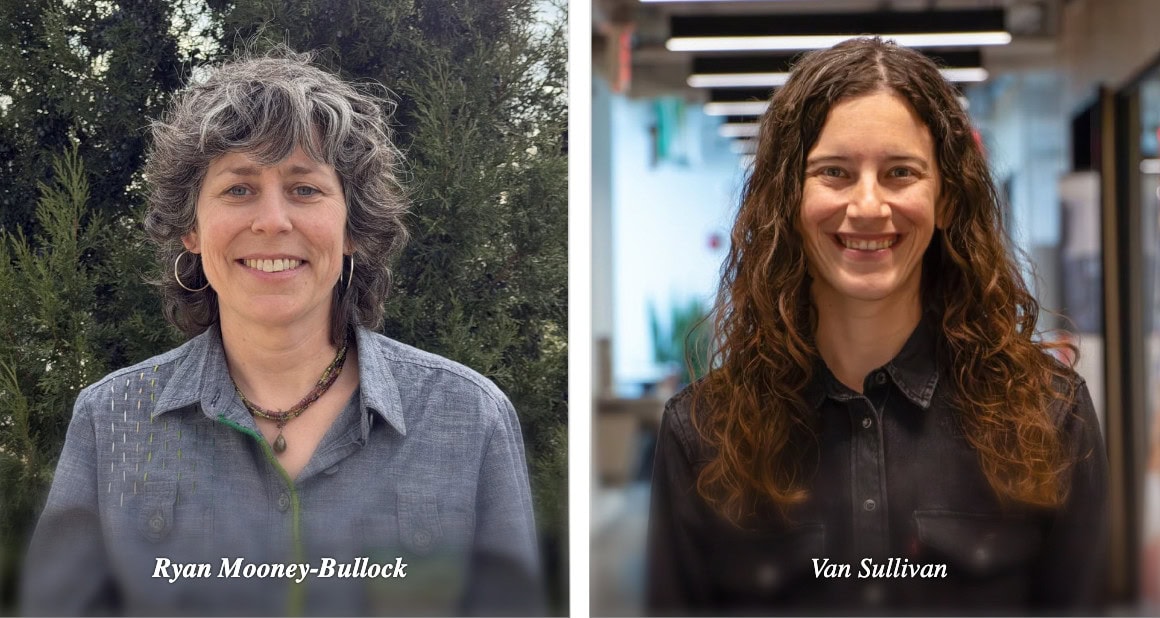
The board named Van Sullivan, Green Umbrella’s senior director of programs and climate strategy, as interim executive director starting Feb. 14. Sullivan, who joined the organization in 2020, shaped the group’s climate policy and community engagement efforts and will work closely with Mooney‑Bullock to ensure a smooth transition.

“We are incredibly thankful for Ryan’s eight years of dedicated leadership and the collaborative culture she has helped build at Green Umbrella,” said board president Jaime Love. “With an experienced interim leader, an engaged board, and a newly adopted strategic plan, we are confident the organization will continue advancing climate and sustainability across our region without missing a beat.”

From regional impact to local stewardship

Mooney‑Bullock will bring her collaborative experience to Gorman Heritage Farm, where she will focus on farm-based education, sustainable agriculture and community engagement. The 122-acre property on Cincinnati’s edge blends farmland, gardens, pastures, wooded hills, hiking trails and a natural pond into a living classroom.

The farm teaches children and adults about agriculture, nutrition, sustainability and the environment through school field trips, camps, workshops and community events. Visitors can interact with farm animals, explore gardens and trails, and see crops and flowers grow, while volunteers of all ages support the farm’s programs. All of these efforts aim to connect people to food, the land, and healthier, more sustainable communities.

Gorman Heritage Farm is a member organization of Green Umbrella.

“We are thrilled to welcome Ryan’s collaborative spirit and strategic vision to Gorman Heritage Farm,” said Andy Mueller, chair of the farm’s board. “Her leadership at Green Umbrella strengthened environmental efforts across Greater Cincinnati, and her background in nonprofit leadership, education and sustainability is exactly what our organization needs.”

Mooney‑Bullock said she’s excited to shift from regional policy work to hands-on stewardship. After nearly a decade of working on policy and systems change at a regional scale, she said she looks forward to focusing on a “specific place and community.”

“I’m excited to be outdoors every day, raising awareness about and supporting a team of farmers, volunteers, and educators who help people build meaningful relationships with the natural world and their food,” she added.

Celebrating achievements and planning ahead

Reflecting on her time at Green Umbrella, Mooney‑Bullock described serving as executive director as an “incredible privilege.”

“It allowed me to build a diverse network of colleagues and partners who I know will carry the work forward to amazing places,” she added.

Green Umbrella will honor Mooney‑Bullock’s tenure at its Annual Impact Celebration on Feb. 10, where it will also highlight its updated strategic plan and priorities for 2026. Love said the organization has a strong foundation for continued growth.

“The organization is the strongest it has ever been and is poised for a period of expanded impact on issues affecting our region’s environment and quality of life,” Love said. “This is an exceptional opportunity for a rising leader to take Green Umbrella to its next stage of development.”

As the organization navigates its first major leadership transition in years, Green Umbrella invites the community, partners, and supporters to engage with its programs and initiatives. From hands-on projects to collaborative regional efforts, the organization encourages involvement at every level.

Even with a new role ahead, Mooney‑Bullock said she isn’t stepping away from Green Umbrella or the community she has worked with.

“I’m deeply grateful to the many partners and supporters who make Green Umbrella’s work possible,” she continued. “I look forward to continuing to work alongside this network.”
Filed Under: Green Umbrella In The News

A regional effort helps Ohio communities step up on climate change

December 4, 2025 by Krystal Gallagher

Source: Yale Climate Connections

Listen to the interview here.

Transcript:

Many municipalities want to cut carbon pollution and prepare for climate change. But of the nearly 200 local governments in the Cincinnati area, only three have a detailed plan to do so.

Van Sullivan is with Green Umbrella, a regional climate collaborative that’s working to change that.

They say a lack of resources and bandwidth is often to blame. Many towns have a small staff to handle everything from budgets to snow removal.

So Green Umbrella created the 25 Communities Project. It provides 25 cities and towns with training, funding, and technical support to cut emissions and prepare for climate impacts.

Sullivan: “So that the local government doesn’t feel like they have to do this work alone.”

To boost capacity, participating communities can be paired with a student fellow who will work for three months to help them advance their goals.

And the initiative will bring the communities together so they can share ideas and partner on projects.

Sullivan says the goal is to create a collaborative regional network of local governments, ready to tackle climate challenges.

Sullivan: “The issues being faced by the communities are similar. … And so it’s about not only creating individual plans but creating a culture of climate planning and collaboration that can move forward for years to come.”

Reporting credit: Ethan Freedman / ChavoBart Digital Media/ Thanks to the Midwest Climate Resilience Conference for logistical support.

Filed Under: Green Umbrella In The News

Cincinnati’s Next Generation of Environmental Activists

December 3, 2025 by Krystal Gallagher

Source: Cincinnati Magazine

On a humid summer afternoon in Burnet Woods, a group of University of Cincinnati students set up their cameras and sound equipment. They’re not filming a music video or a class project—they’re producing an educational series on birdwatching, water quality, and the ecological wonders of one of the city’s parks. The project, funded by the City of Cincinnati’s Seeds of Change Youth Climate Action Grants, reflects a growing truth: young people aren’t waiting for someone else to save the planet. They’re doing it themselves, one community garden at a time.

Seeds of Change Grant Program recipients conduct gardening experiments.
Photograph: Seeds of Change

“Plenty of youth involved in these projects are under 18 and can’t even vote,” says Rachel Bickett, sustainability project coordinator with the City of Cincinnati’s Office of Environment & Sustainability. “But that doesn’t stop them from shaping the way their city looks through their hard work and dedication to making their communities more sustainable, equitable, and resilient.”

That philosophy, activating local solutions led by local youth, is at the heart of Cincinnati’s Seeds of Change Grant Program, a community-driven initiative launched as part of the city’s Green Cincinnati Plan. The program invests in grassroots sustainability projects across neighborhoods, many of which directly involve or are entirely led by young people.

Since its start, it has funded more than 100 projects with over $500,000 in awards, reaching nearly 6,000 residents. The goal is to hit $1 million in community climate investments by 2028.

Though climate change has long been framed as an issue for the next generation, for today’s youth, the crisis isn’t in some distant future; it’s now. Flooding, extreme heat, and poor air quality are already reshaping their daily lives in Cincinnati, especially in neighborhoods historically hit hardest by environmental inequities.

“With 84% of youth around the world reporting that they’re worried about climate change, it’s critical that we continue to value and support youth voices and action,” Bickett says.

That support in Cincinnati takes many forms. While Seeds of Change provides the funding and framework, local nonprofits are building the programming that empowers youth to step into climate leadership. Green Umbrella’s Green Schoolyards Action Network and Groundwork Ohio River Valley’s Green Team and Green Corps are two of the most visible examples, offering hands-on experiences that blend environmental education, workforce training, and community impact.

For Ryan Mooney-Bullock, executive director of Green Umbrella, the classroom doesn’t stop at the school door. “The Green Schoolyards Action Network is working to ensure that students have access to time outside in natural spaces as a part of their school experience,” she says. “We know not every family prioritizes that, and we think it’s too important to leave that up to chance.”

Over the past five years, Green Umbrella has partnered with Cincinnati Public Schools to design and implement green schoolyards across the district that feature outdoor classrooms, native gardens, vegetable plots, fruit trees, and tree canopies that provide shade and stormwater absorption.

Green Umbrella’s Green Schoolyards Action Network
Photograph: Kelly St. Charles

“It’s not just kids going out onto an asphalt playground and calling that time outside,” Mooney-Bullock explains. “It’s time outside where they’re really interacting with the natural environment.”

The impact is already evident. At Aiken High School, students cultivate produce in their garden that they are working to be able to sell to the cafeteria, learning food safety standards alongside horticulture. Teachers are equipped with toolkits and professional development to weave outdoor education into their lesson plans. For students, it’s more than just a science class.

“It’s really transformative,” Mooney-Bullock says. “Students tell us it’s their favorite class. They look forward to being out in the garden. They’re learning so much about themselves, each other and how to care for their environment.”

While Green Umbrella is reshaping what learning looks like inside the district, Groundwork Ohio River Valley is focused on what comes next: jobs.

“Our Green Team is a youth-focused workforce development program for ages 14 to 18,” says Executive Director Sarah Kent. “For many of them, it’s their very first job. They’re learning accountability, like showing up on time and packing their lunches, and they’re doing meaningful work in their own neighborhoods.”

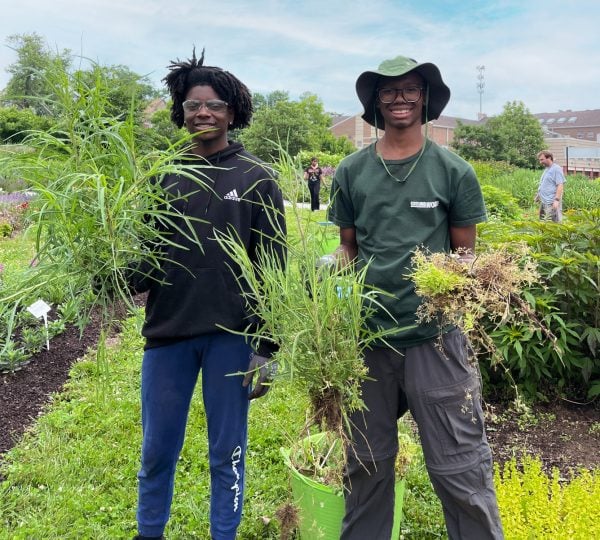
Groundwork Ohio River Valley Green Team and Green Corps participants
Photograph: Groundwork Ohio River Valley

That work ranges from planting community gardens in Madisonville to restoring trails in Mt. Echo Park. In the summer, teams might be stationed at the Cincinnati Zoo, where they learn horticulture and environmental management while also working in the surrounding community of Avondale.

The Green Corps, Groundwork’s program for young adults 18 to 26, takes it further. Participants earn professional certifications funded through the U.S. Department of Agriculture’s Forestry Service and the U.S. Environmental Protection Agency’s Brownfields grants that prepare them for careers in energy, conservation, and environmental engineering. Many go straight into jobs with partners like Cardinal Land Conservancy or the Cincinnati Parks Department.

“We try to expose them to as many different people as possible,” Kent says. “Park rangers, EPA engineers, you name it. If they can connect with one of those topics, they can figure out what they want to do for their future.”

Together, these programs are tackling climate change at both the micro and macro level. Green Schoolyards address equity in education and exposure to nature, while Green Team and Green Corps strengthen neighborhood resilience with green infrastructure. Seeds of Change ties it all together with funding and recognition that community-driven ideas matter.

In the West End, Groundwork plans a large tree planting, with hopes of eventually funding a neighborhood-specific Green Team. In Lower Price Hill, youth have collected data on air quality for six years, informing where trees are planted to combat pollution. Across the city, schoolyards now feature pollinator gardens and rain-absorbing landscapes that help mitigate flooding.

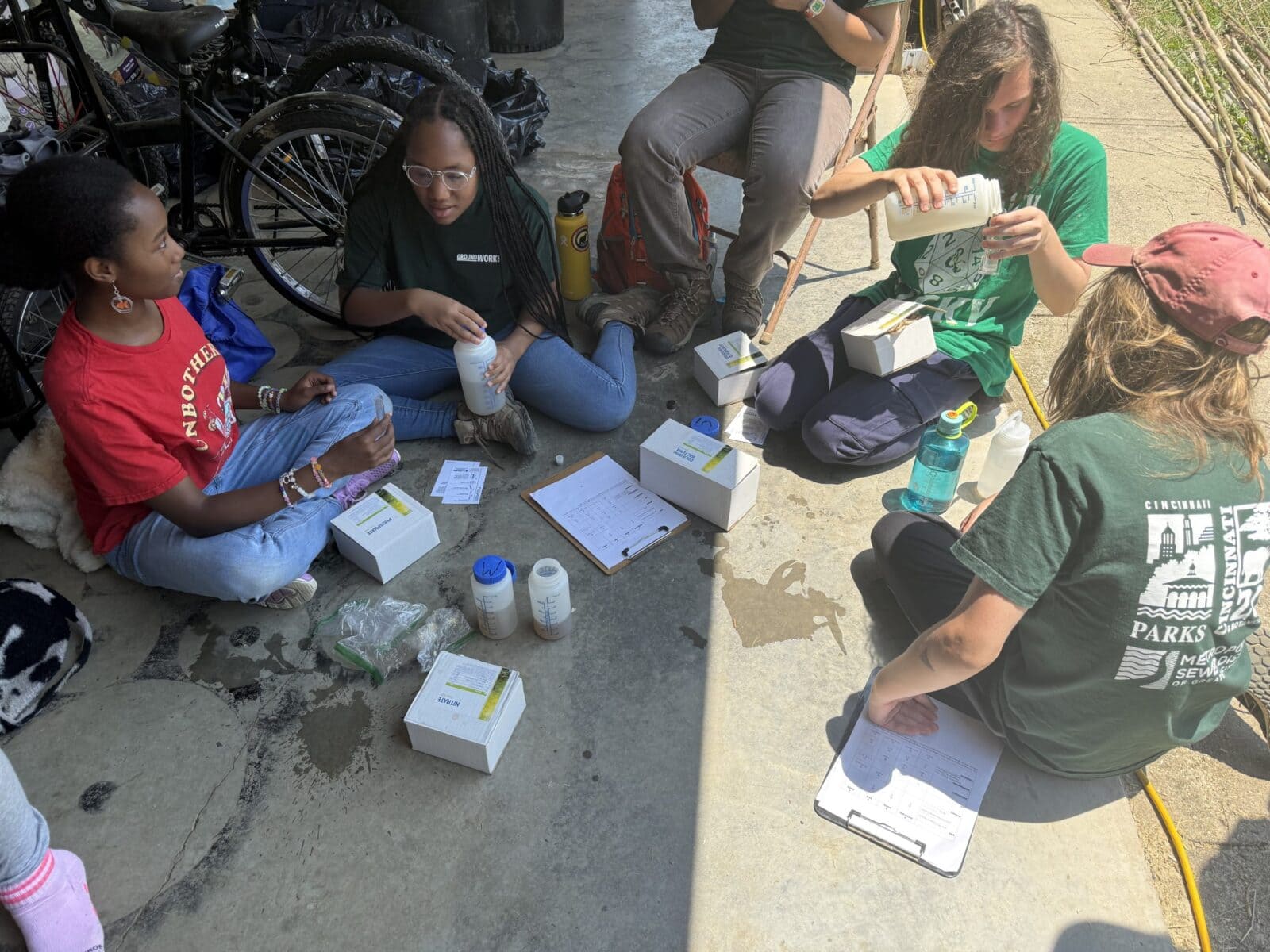
Groundwork Ohio River Valley Green Team and Green Corps participants
Photograph: Groundwork Ohio River Valley

“These projects show that youth-led initiatives aren’t just symbolic,” Bickett says. “They’re creating real, measurable improvements in Cincinnati’s neighborhoods.”

And the ripple effect goes beyond the environment. Youth who participate gain confidence, leadership skills and career pathways. Communities see the real impact of young people investing their time and creativity into local solutions. And many residents who face economic and environmental disadvantages experience the pride of seeing their neighborhoods transformed.

But none of this work is without challenges. Recruiting busy teenagers to apply for grants, convincing maintenance crews not to mow down native wildflowers and finding sustainable funding all remain ongoing struggles. But the momentum remains strong. “We’ve been extremely proud of the hard work led by grantees so far and are dedicated to making the program more accessible and impactful in years to come,” Bickett says

For Mooney-Bullock, the payoff is personal. As both an environmental educator and a parent of four Cincinnati Public Schools students, she sees firsthand the difference outdoor experiences make. “It expands their perspective on the world and connects them with themselves, each other, and the environment. That’s one of my core values, that everyone should feel comfortable in natural spaces, even if they don’t end up as nature junkies like me.”

Kent echoes that sentiment talking about the end-of-summer celebration where Groundwork youth share posters showcasing their projects. “Everyone is excited, even though they’ve done different things,” she says. “It’s really cool to see them brag about their work. That pride comes naturally because they know they’ve made a difference.”

Seeds of Change is betting that those seeds of pride, leadership, and resilience will grow into something lasting.

“Climate anxiety is real and scary,” Bickett says. “But the best remedy is positive action. We’re in this together. And Cincinnati has no shortage of opportunities for young people to contribute in real, meaningful ways.”

Filed Under: Green Umbrella In The News

Green Umbrella’s First Ever Wasted Food Summit Coming to Memorial Hall

October 24, 2025 by Krystal Gallagher

Source: Cincinnati Magazine

According to Green Umbrella Regional Climate Collaborative, nearly 60 million tons of food get thrown away every year—around 40 percent of all food produced. That’s why Green Umbrella is teaming up with Last Mile Food Rescue and Hamilton County ReSource to hold the Wasted Food Summit at Memorial Hall in Over-the-Rhine on Wednesday, October 29. The summit is focused on creating awareness of food sustainability and providing paths for both advocates and businesses to tackle this issue head on.

There will be two keynote speakers at the summit: ReFED Executive Director Sara Burnett and Chef Alejandra Schrader, a previous contestant on MasterChef and author focused on zero-waste cooking. Other panelists include executives and representatives from companies and organizations like Kroger, the World Wildlife Fund, and the Ohio Environmental Protection Agency.

“We have a wide range of experts who are going to be sharing insights throughout the day on how businesses can safely donate food … and how individual advocates can be part of the movement to help rescue food in our region,” says Charlie Gonzalez, the director of engagement and strategic partnerships at Green Umbrella.

Some of these experts come from Last Mile Food Rescue, a nonprofit logistics company that works with more than 300 food donors and 100 different agencies to distribute would-be wasted food to the public. Erik Hyden, the director of new business partnerships and food donations for Last Mile, is a speaker in one of the panels at the event. As well as being on the ground giving tours around the Queen City, Hyden hopes that the increased awareness of food donations and limiting food waste will help many organizations around the city.

“There are so many things we see when we turn on the news, and we see insurmountable problems,” says Hyden. “To be honest, it seems hard to help. But, with food insecurity, that is something that can be solvable.”

Thanks to the Sustainable Agriculture Research and Education division of the U.S. Department of Agriculture, the summit is the first of many events slated. Plans are in the works for an educational food waste series in 2026 and a follow-up summit in 2027, all led by Green Umbrella and Last Mile.

The Wasted Food Summit will take place at Memorial Hall on Wednesday, October 29, from 9 a.m.–2:30 p.m. with tours offsite before and after the event. Admission is $25.

Filed Under: Green Umbrella In The News

Cincinnati provides $850K grant to community organizations to address food insecurity and gun violence

October 23, 2025 by Krystal Gallagher

Source: WCPO

CINCINNATI — The City of Cincinnati gave an $850,000 grant to more than a dozen local organizations, including Cincinnati Children’s Hospital, in an effort to address food insecurity and reduce gun violence.

Provided by the Cincinnati Office of Human Services, the grant is the city’s 2026 Impact Award. It’s the second award given since the program was created in 2024 to tackle systemic problems.

The city said the program aims to form a network of food resource hubs and urban farms in high-risk neighborhoods. In the first year of the program, hubs will be created in Avondale, East Price Hill and the West End.

The program was designed to engage specifically with gun violence survivors, system-involved youth and public school students, the city said.

“There’s a direct connection between experiencing food insecurity and experiencing gun violence, either as a victim or a perpetrator,” said City Manager Sheryl Long.

Hubs will offer food, connection to other services and opportunities for community building.

The Impact Award will also fund urban farming operations, which are expected to grow tens of thousands of pounds of produce and create jobs for neighborhood residents, according to the city.

Here’s a full list of the organizations that received funding for the program:

  • Closing the Health Gap
  • Cincinnati Children’s Hospital Medical Center
  • Feed the Soul
  • Green Umbrella
  • La Soupe
  • Urban Farming Initiative
  • Love in Action
  • Whole Again
  • Findlay Market
  • Greater Cincinnati Resilience Coalition
  • Isaiah 55, Inc.
  • Lord’s Gym
  • Verge Monarch
  • Produce Rx

The grant is paid for by Cincinnati’s general fund, according to the city.

Filed Under: Green Umbrella In The News

Cincinnati awards $850,000 to combat gun violence, address food insecurity

October 23, 2025 by Krystal Gallagher

Source: Spectrum News 1

CINCINNATI — The city of Cincinnati is looking to make an impact through a new grant aimed at addressing food insecurity and reducing gun violence. 


What You Need To Know

  • An $850,000 grant was awarded to Cincinnati Children’s and other community partners through the city’s Office of Human Services
  • The city said it is designed to engage three vulnerable populations: gun violence survivors, system-involved youth and public school students
  • Three neighborhood hubs will be established in the first year in Avondale, East Price Hill and the West End

An $850,000 grant was awarded to Cincinnati Children’s and other community partners through the city’s Office of Human Services. The funds are designed to create a program to run a network of food resource hubs and urban farms in high-risk neighborhoods. 

The city said it is designed to engage three vulnerable populations: gun violence survivors, system-involved youth and public school students.

“Food is the most fundamental thing we have, and lack of access to food very rapidly leads to deteriorating communities,” said City Manager Sheryl Long in a news release. “While it may not be obvious, there’s a direct connection between experiencing food insecurity and experiencing gun violence—either as a victim or a perpetrator.”

Dr. Carley Riley, a Cincinnati Children’s pediatrician who is steward of Community Systems Science with the health system’s Michael Fisher Child Health Equity Center, said the System to Achieve Food Equity network has helped improve nutrition security since 2020.

“We have now grown into a community-based, cross-sector network of over 350 individuals and more than 130 organizations,” Riley said in a news release. “By partnering with ACT for Cincy, a city of Cincinnati initiative that builds on a public health approach to violence prevention, both organizations will be able to together address one of the root causes of the complex problem of violence – while helping to make our neighborhoods safe and vibrant through community well-being and providing sustainable access to food and opportunity.”

Three neighborhood hubs will be established in the first year in Avondale, East Price Hill and the West End that will offer food, connection to other services and community building. 

The Impact Award will also fund urban farming operations with partners expecting to grow tens of thousands of pounds of produce and create jobs for neighborhood residents. 

Funded partners include:

  • Closing the Health Gap
  • Findlay Market
  • Feed the Soul
  • Greater Cincinnati Resilience
  • Green Umbrella
  • Isaiah 55, Inc.
  • La Soupe
  • Lord’s Gym
  • Urban Farming Initiative
  • Verge Monarch
  • Love in Action
  • Produce Rx
  • Whole Again

This is the second Impact Award granted by the city. For more information on ACT for Cincy, click here.

Filed Under: Green Umbrella In The News

Dearborn Co. Planning & Zoning to Host Second Comprehensive Plan Workshop

September 2, 2025 by Krystal Gallagher

Source: Eagle Country Online

(Lawrenceburg, Ind.) – Community members are invited to attend the Dearborn County Comprehensive Plan Update Workshop.

Dearborn County Planning and Zoning will host their second public workshop on Thursday, September 25 from 6:00 to 8:00 p.m. at the Dearborn County Government Center.

The goal of the workshop is to gather community input to help develop community-wide goals, objectives and policies with meaningful standards of implementation over the years to come.

Workshop topics for this meeting are Environmental / Natural Systems and Economic Development. 

There will also be short presentations from Dearborn County Soil and Water, Green Umbrella and One Dearborn.

If you can’t come to the workshop, watch all the activities from home on YouTube by clicking HERE.  Click here (PDF) to view the Planning Survey

Completed surveys can be emailed to ndaily@dearborncounty.in.gov or by mail to 165 Mary Street, Lawrenceburg, IN 47025 or delivered to the Planning and Zoning Office at the Dearborn County Government Center.

Filed Under: Green Umbrella In The News

Green Umbrella study moves forward with private funding after grant termination

August 24, 2025 by Krystal Gallagher

Source: WVXU

A study on energy efficiency in low-income housing is moving forward, months after the Trump administration terminated the grant funding it.

Environmental nonprofit Green Umbrella says it and its research partners now have enough private funding to continue the project, which involves weatherizing and electrifying affordable apartments with Over-the-Rhine Community Housing.

Executive Director Ryan Mooney-Bullock says Green Umbrella will soon be able to install new insulation and updated HVAC systems into the apartments.

“There’s a lot of assumptions that have been made about what will happen when you make these types of improvements within housing units, but there have not actually been studies that have really shown through the entire process, what does this feel like? What do the residents of these units experience?” Mooney-Bullock said.

Green Umbrella, along with researchers from Indiana University, Carnegie Mellon University, and the University of Pennsylvania, also is surveying residents to gain insight into those questions.

Mooney-Bullock says she hopes their findings can help households across the country reduce their energy bills and consumption.

“As we seek to move forward with lower energy use and green sources of energy — not just for the folks who can afford solar panels on their houses, but people who are living in all types of housing — we knew it was really important information that we wanted to be able to continue to study,” Mooney-Bullock said.

Green Umbrella plans to share the study publicly once it is complete.

The nonprofit received a $1.1 million award from the Environmental Protection Agency in 2023 for the energy study. In May, Green Umbrella learned its grant had been terminated because it is “no longer in alignment with the EPA’s priorities.”

The nonprofit disputed the termination with the EPA, but says it hasn’t heard anything back yet.

Filed Under: Green Umbrella In The News

Green Umbrella now accepting applications for 2025-26 Climate Research Incubator Cohort

August 23, 2025 by Krystal Gallagher

Source: NKY Tribune

Green Umbrella is accepting applications for its second annual Climate Research Incubator (CRI).

The cohort links scholars and researchers with community members and government representatives across Greater Cincinnati, bridging the gap between research and practical steps that positively impact communities.

Participants receive training in community engagement, collaborative research design, and climate justice. Following the training, the program hosts workshops and an annual symposium. Thanks to the program sponsor, CRI project seed funding will be available to apply for at the end of the program.

“The Climate Research Incubator was designed to catalyze regional climate research that centers community need and expertise,” says Van Sullivan, Senior Director of Programs and Climate Strategy at Green Umbrella. “Since 2023, we’ve trained 20 researchers across 15 specialties and connected over 100 community leaders to shape local discovery and outcomes that address frontline needs.”

Applicants should be researchers, scientists, and/or graduate students specializing in expertise or research that directly addresses climate changes. Participants should be committed to achieving measurable impact and creating actionable, community-driven solutions to problems. Visit the link here to learn more and submit your application here. Applications are due on Friday, September 5, 2025.

The 2024 CRI cohort trained 12 local researchers across five institutions and 10 research specialties in climate and environmental science fields, engaging with six local governments and 26 community leaders.

Major seed ideas emerged and project teams have continued moving work forward on projects in food systems, greenspace, waste reduction, and community health. Two projects from this cohort successfully secured grant funding through the UC Coalition for Change and Ohio EPA.

Filed Under: Green Umbrella In The News

Green Umbrella fellows finish internship with City of Oxford

August 18, 2025 by Krystal Gallagher

Cover image: Kate Kozak and Oluwaseun Olubodun running a waste station in the Uptown park. Photo provided by Reena Murphy.

Source: Oxford Free Press

This summer, the City of Oxford welcomed two interns, Oluwaseun Olubodun and Kate Kozak, from the Climate Action Fellowship offered through Green Umbrella. 

Green Umbrella is a non-profit organization that connects people, organizations and local governments in the greater Cincinnati area to “take decisive action in the face of climate change.”

This summer marked the second year that Oxford welcomed interns from the Climate Action Fellowship. These fellows work on projects both provided by Green Umbrella as well as relevant tasks for the city. 

Olubodun has studied at Miami University since 2019, first as a master’s student and now working towards her Ph.D. in the ecology, evolution and environmental biology program. Kozak is entering her junior year at Ohio State University as an environment, economy, development and sustainability major. 

Green Umbrella paired the two up to work in Oxford starting in late May under Reena Murphy, Oxford’s sustainability coordinator and the host site supervisor for the fellowship. 

“It’s a great collaboration for Oxford in the region,” Murphy said. “It’s a great way to learn from each other, and it’s a good way to get new perspectives and ideas in our community and really start chipping away at some of our long-term goals. I’m super grateful for the fellowship and the work these two have done this summer.”

Over the summer, the duo worked on various projects for Green Umbrella, such as energy benchmarking and climate budgeting, as well as other priorities for the city. Olubodun researched stormwater management funds, and Kozak concentrated on waste management. 

For Olubodun, the experience this summer differed from her typical work in the lab and in school because it allowed her to see how her research affects Oxford.  

“Being in the lab, you kind of forget the essence of a bigger picture,” Olubodun said. “We’re doing procurement, we’re doing energy benchmarking, we’re doing community wealth, [but] what’s the whole point of it? Why are we doing it? Why is it important? … So being able to take a step away from my regular activities and see how everything makes sense with the lens of sustainability, I think that’s what is very important to me.”

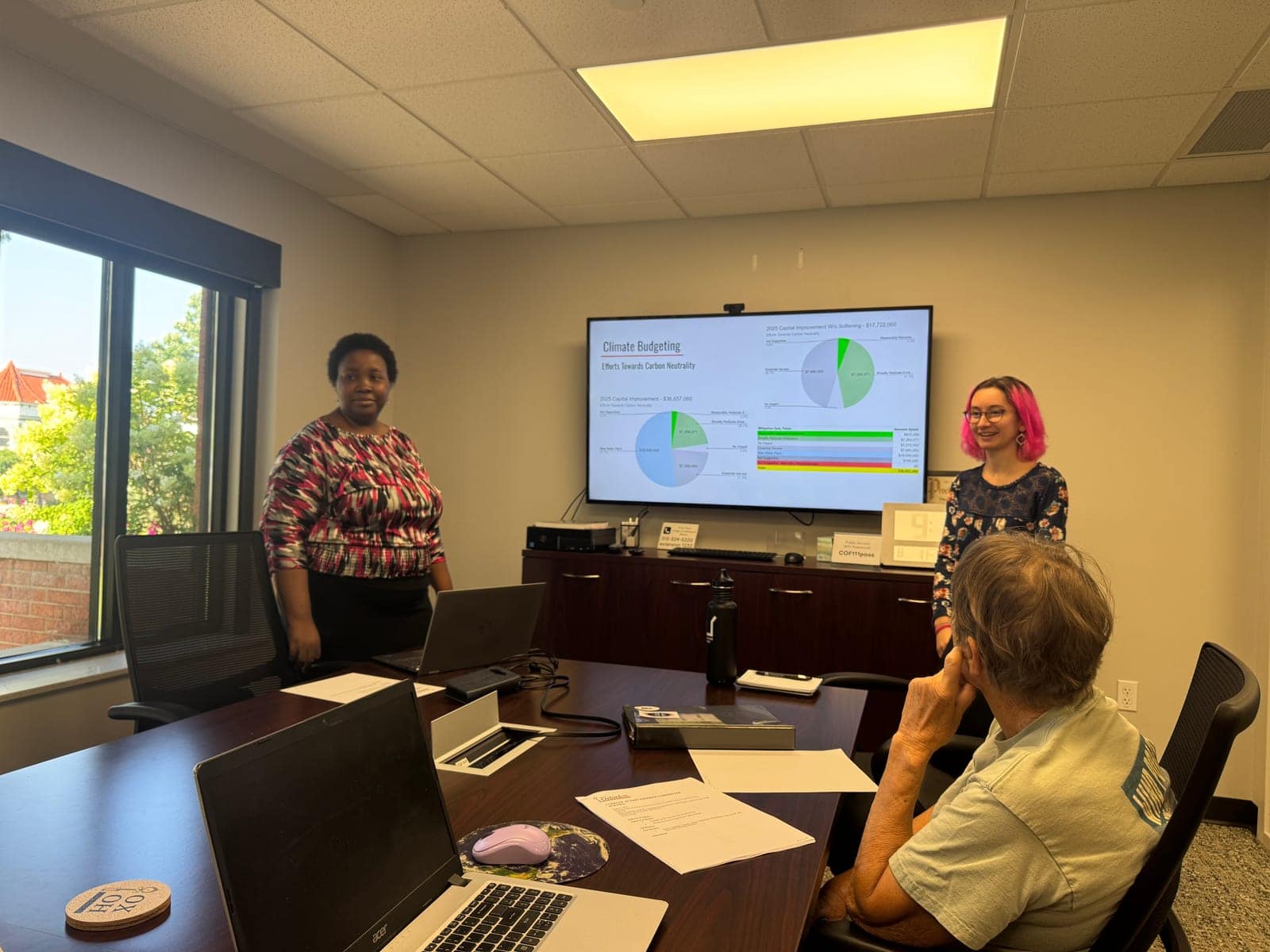
Beyond researching, Olubodun and Kozak also presented their findings throughout the summer to various Environmental Commission and Climate Action Steering Committee meetings. 

“Everybody was really nice,” Kozak said. “They asked so many questions. It was really kind of a jumping-off point. I shared the information, and they were like, ‘Okay, now how does this more directly apply to Oxford?’”

Kate Kozak and Oluwaseun Olubodun presenting their research from the summer to the Climate Action Steering Committee. Photo by Kethan Babu.

The interns only worked for the city over the summer. Despite their brief time, however, Kozak said everyone she worked with was welcoming and excited to introduce her to Oxford. 

“Considering that we’re only here for 10 weeks, they don’t necessarily have to get to know us,” Kozak said. “I think it’s really nice that people are putting in an effort to be nice. We’ve met people in other departments, and we’ve gone on various tours of places. All city staff members [want] to answer our questions, and they want to show us around town.”

Their research and work since arriving in Oxford has given both interns valuable experience in their fields, as well as introducing them to experts in different industries. Kozak said working on these projects, including a climate budgeting project that analyzed the city’s capital improvement plan through a sustainability lens, has taught her about what she likes in terms of data and research. 

Outside of working for the city, the interns have enjoyed spending time at the summer events in Oxford. From Freedom Festival to Red Brick Fridays, they have been able to see the people in Oxford that their work impacts.  

“It’s so nice,” Kozak said. “We’ve been at these community events for the waste stations, [and] that’s been my favorite part. It’s so nice to see all the people come out and get together … I think it’s very pretty around here, and everyone cares about sustainability, so that’s been uplifting as well.”

The fellowship term ends on Aug. 8. Kozak and Olubodun will attend the fellowship showcase on Aug. 20, where they will share their experiences with interns from other cities at the University of Cincinnati. 

Although this is only the second summer that Oxford participated in the Green Umbrella Climate Action Fellowship, Murphy said the city would love to continue participating and highlighted the benefits to both the interns and the city. 

“I just have a soft spot,” Murphy said. “I started in the city as an intern during my graduate program. The best way to learn is to do and to see what local government is all about.”

Filed Under: Climate Action Fellowship, Green Umbrella In The News

Green Umbrella to host 2025 Climate Action Showcase with local governments August 20

August 1, 2025 by Krystal Gallagher

Source: NKY Tribune

Green Umbrella will host a Climate Action Showcase Aug. 20 for the local governments participating in this year’s Climate Action Fellowship program.

The communities are:

  • City of Newport
  • City of Fairfield, Ohio
  • Hamilton County, Ohio
  • City of Milford, Ohio
  • City of Oxford, Ohio

Government leaders from each community, together with their Climate Fellows, will discuss how they started or furthered their climate action planning process and projects.

The event will be held Wednesday, August 20, 3:30-5 p.m. at the UC Digital Futures building, Room 140, 3080 Exploration Avenue, Cincinnati.

Green Umbrella will share opportunities that any community can embrace to take next steps to prepare their community for environmental change and access funding to improve infrastructure, build community resilience, and save money.

There will also be time to connect with the Fellowship participants, government leaders, and partners to learn how your community can take next steps.

The event is free and open to the public. Learn more and register at greenumbrella.org.

Fewer than 10 local governments in the region have a sustainability plan. Green Umbrella’s Climate Action Fellowship program pairs undergraduate and graduate students, and individuals who want to pivot careers, with local governments to develop practical plans and solutions for a changing climate.

Local governments receive research support, added capacity, and assistance in sustainability planning. Fellows receive invaluable experience in the public sector, networking, and professional development support.

The 2025 Climate Action Fellows are supported by the Greater Cincinnati Foundation and The Nature Conservancy.

Green Umbrella

Filed Under: Green Umbrella In The News

Green Umbrella fellowship grows local climate action, future leaders

July 31, 2025 by Krystal Gallagher

Source: Movers & Makers

Green Umbrella is doubling down on its mission to help local governments tackle climate change – and building the next generation of sustainability leaders along the way.

The nonprofit’s Climate Action Fellowship returned for a second year this summer, expanding from three to seven fellows placed in five local governments: Hamilton County, Oxford, Fairfield, Milford in Ohio and Newport, Ky.

Running from May 28 through Aug. 8, the 10-week program gives fellows hands-on roles advancing public-sector climate action – from developing sustainability plans to mapping green infrastructure and engaging school districts.

The current cohort will wrap up on Aug. 8, with a public showcase on Aug. 20 where fellows will present their work to local leaders, partners and prospective employers.

Climate Fellows group photo (left to right): Ava Heffernan, Shobha Pai, Kate Kozak, Constance Kammerer, Rachel Cranmer, Oluwaseun Olubodun and Jackson Hare.

“This fellowship delivers real capacity to local governments and helps communities act on climate with urgency,” said Van Sullivan, Green Umbrella’s senior director of programs and climate strategy. “At the same time, it’s training future leaders who understand that systems change starts locally.”

Tailored projects, tangible impact

Launched in 2024 as a small pilot in Covington, Milford and Oxford, the program aims to help local governments expand capacity in their sustainability efforts and grow a diverse pipeline of future leaders.

This year, each participating organization is completing four core projects focused on climate planning, procurement, budgeting and community wealth building. Fellows then help shape additional work based on local goals – all in close collaboration with government staff.

Two fellows, Ava Heffernan and Shobha Pai, have worked this summer assisting Hamilton County draft its first sustainability plan, a strategic document that outlines approaches to integrating social, environmental and economic considerations into its operations and decision-making processes. They’ve reviewed existing policies, led early engagement efforts and analyzed county services to better understand how they could improve operations and overcome any coverage gaps.

Heffernan said working with Brad Johnson at Hamilton County’s Department of Environmental Services gave her insight into policy-making and community engagement that she couldn’t get in the classroom.

“It’s been incredibly rewarding to contribute to such meaningful and lasting work,” she added.

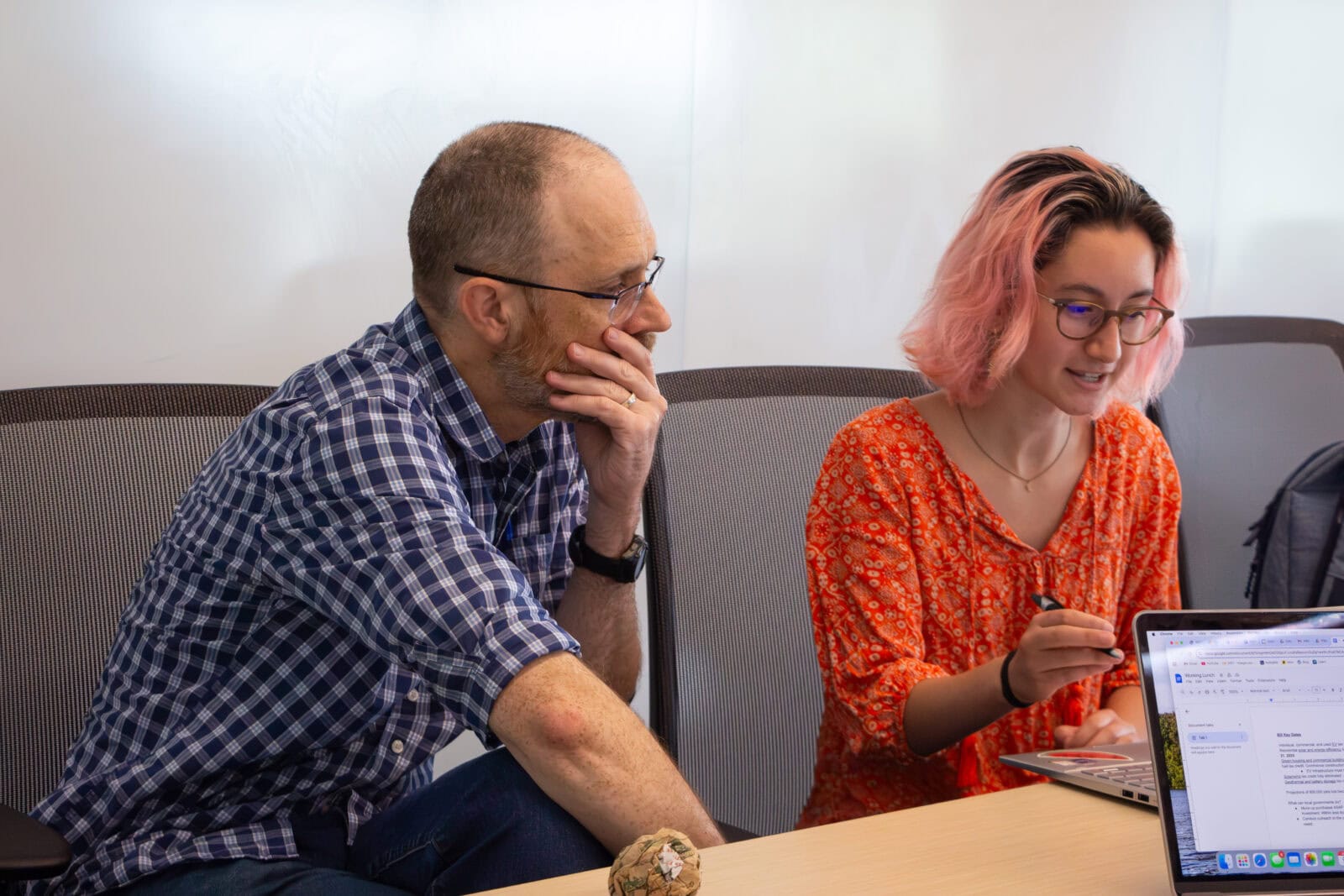
Wyatt King, director of the Greater Cincinnati 2030 District, with fellow Kate Kozak at a working session.

In Milford, Jackson Hare, a recent Xavier University graduate, is partnering with city leaders to boost sustainability commission outreach, assess greenspace and climate resilience, and track energy use in municipal buildings.

Oxford fellows Kate Kozak and Oluwaseun Olubodun are supporting stormwater funding research and zero-waste efforts, while also engaging students and benchmarking city facilities, all under the guidance of Sustainability Manager Reena Murphy.

Newport fellow Rachel Cranmer is working alongside municipal specialist Josh Tunning to promote sustainable purchasing, evaluate parks, identify tree-planting opportunities, and build climate education partnerships with local schools.

Graduate student Constance Kammerer is helping lead Fairfield’s sustainability tracking efforts, teaming up with Program Manager Gillian Hart to design internal and public metrics for the city’s “Fairfield Sustains” plan.

The fellows have taken part in activities as a group, including collaborative learning sessions throughout the summer, gaining exposure to real-world sustainability practices and partnerships in action. As a group, they toured Cincinnati Public Schools’ green schoolyards to see how cities, school districts and nonprofits are working together to create outdoor learning spaces that promote environmental education, youth wellness and climate resilience.

Fellows’ visit to the greenspace at Aiken New Tech High School in College Hill. The person standing is Aaron Parker, Aiken teacher and agricultural career tech pathway educator.

One of their working sessions included time with Wyatt King, director of the Greater Cincinnati 2030 District – a public-private initiative facilitated by Green Umbrella that unites property owners, developers, commercial tenants and community groups in a shared commitment to cut energy use, water consumption and transportation emissions by 50% by 2030.

“I have always been pulled to get involved in my community, and getting engaged with local government felt like the perfect way to tie that into my career,” Kammerer said. “This experience with Green Umbrella and Fairfield has given me a chance to see how different parts of local government function, and learn where I could fit in this space.”

A regional strategy with momentum

The fellowship is part of Green Umbrella’s broader push to accelerate climate action across its 10-county, three-state region.

Right now, fewer than 10 local governments in the area have a sustainability plan. Green Umbrella is working to change that through its network of more than 200 businesses, governments, nonprofits and educational institutions – all collaborating to reimagine outdated systems and drive progress.

Green Umbrella has launched numerous initiatives such as the new 25 Communities Project, which provides technical support to local governments across the region, with a focus on helping more historically underserved communities plan for climate resilience.

But the annual Climate Action Fellowship has become a key part of that strategy. It helps local governments build capacity while also preparing a diverse pipeline of future climate leaders. So far, fellows have:

  • Completed 25 projects
  • Helped three communities create sustainability commissions
  • Initiated three climate planning processes
  • Benchmarked 12 public buildings for energy efficiency.

The fellowship will be offered again next year as part of the 25 Communities Project. Greater Cincinnati governments can sign up to participate today by reaching out to Sullivan.

“Only 1% of regional jurisdictions have a sustainability plan right now,” Sullivan said. “This fellowship lays the groundwork for more community plans by delivering training, creating jobs, engaging communities, identifying future funding opportunities and implementing projects.”

Thanapat Vichitchot from the City of Cincinnati’s Office of Environment and Sustainability leads a training at the Climate Action Fellowship Training.

The successes of this year’s fellowships will be on display Aug. 20 at the Climate Action Showcase – a public event at UC Digital Futures Building where fellows and local leaders will share how they kicked off or advanced climate planning efforts this summer. Green Umbrella will also outline simple steps any community can take to get started, access funding and build a more resilient future.

The showcase is free and open to all.

And if you’re wondering what kind of impact the program really has, just talk to any of this year’s fellows or those they’ve worked with over the past two and a half months.

“It’s inspiring to see how much can happen over the course of a summer when local governments commit time and energy to exploring what local climate action can look like for them, and have access to the expertise and people power,” said Ryan Mooney-Bullock, Green Umbrella’s executive director. “I am excited to follow the trajectory of these communities and professionals over the next five years as their impact becomes evident.”

Filed Under: Green Umbrella In The News

  • « Previous Page
  • 1
  • 2
  • 3
  • 4
  • …
  • 9
  • Next Page »
Green umbrella Logo
  • Careers

  • Contact

  • FAQs

stay connected

subscribe to our Newsletters
© 2026 Green Umbrella. All Rights Reserved.
Privacy Policy · Website by Wonderly.