Under Our Umbrella: A Year of Collective Impact
By Kelly Morton
Published February 11, 2026
Join us and act against climate change! Learn how you can get involved.


In the United States, over 60 million tons of food - almost 40% of what’s produced - is wasted every year, costing producers hundreds of millions of dollars in lost profit. And yet millions of people face food insecurity daily.

In the United States, over 60 million tons of food – almost 40% of what’s produced – is wasted every year, costing producers hundreds of millions of dollars in lost profit. And yet millions of people face food insecurity daily. The solution seems obvious: waste less food. But anyone in the food industry will tell you that it’s not so simple. Between weather anomalies, transportation logistics, supply chain issues, product shelf life, and consumer constraints, food waste can feel inevitable for producers, sellers, and consumers.
What can we do? By preventing and recovering wasted food, we can tap into the economic potential of a valuable resource AND mitigate food insecurity.
Food can be lost at every step in production, retail, and in our own homes. On farms, unusual weather can prevent harvesting, or unpredictable market prices can mean profits are lower than the cost to harvest and transport the food. A harvest can then be left to rot in the field, or it’s dumped after being harvested if a delay compromises its shelf life.
In stores, food past its expiration date is routinely thrown away. Blemished, bruised, or wilted produce is pitched. Dented and damaged packaging means the product gets picked over before being discarded into the dumpster. In restaurants and food service industries, a mistake in food ordering or change in customer preference triggers an ingredient surplus. Planning to use all aspects of an ingredient is difficult (offal and bones, for example), leaving food-prep remnants heading straight to the garbage.
Even in our own kitchens, where we have control over what we buy, cook, and serve, wasted food is a common problem. A head of lettuce gets wedged in the back of the fridge, forgotten until it turns brown and soggy; a gallon of milk sours before you drink it all; a box of cereal left open by mistake goes stale overnight.
For the farmer, processor, retailer, manager, chef, business owner, and consumer, throwing away food is throwing away the money used to produce the food, and throwing away its potential.
Alongside this money and potential lost through wasted food, 13.5% of households in the United States are food insecure, meaning that their diets and eating habits have been impacted by lack of or restricted access to food. In Cincinnati, more than 270,000 families, from across all of the city’s 52 neighborhoods, experience food insecurity every year.
Most food thrown away goes into the trash and heads to the dump, with discarded food making up 24% of the waste in U.S. landfills. As it rots in landfills, the organic material releases methane, a greenhouse gas 28 times as powerful as CO2 at trapping heat in the atmosphere. Throwing that wilted broccoli into the trash doesn’t seem like a big deal, but when all the producers, businesses, and consumers in the country each throw their broccoli on the pile, it leads to a significant cause of global warming.
A trash-can alternative for food waste is compost. Composting is a way of recycling organic matter, using oxygen, bacteria, fungi, and even organisms like worms and beetles to turn organic waste into compost, which often looks like garden soil. Compost is sometimes called “black gold” because it is extremely rich and beneficial for growing new crops. Composting food waste prevents the methane emissions that are generated when food waste sits in a landfill. Composting also creates a valuable source of fertilizer for farmers and backyard gardeners. When food cannot be salvaged for consumption by people or animals, composting food waste is the superior choice for the planet (and your pocketbook) than sending it to the landfill.
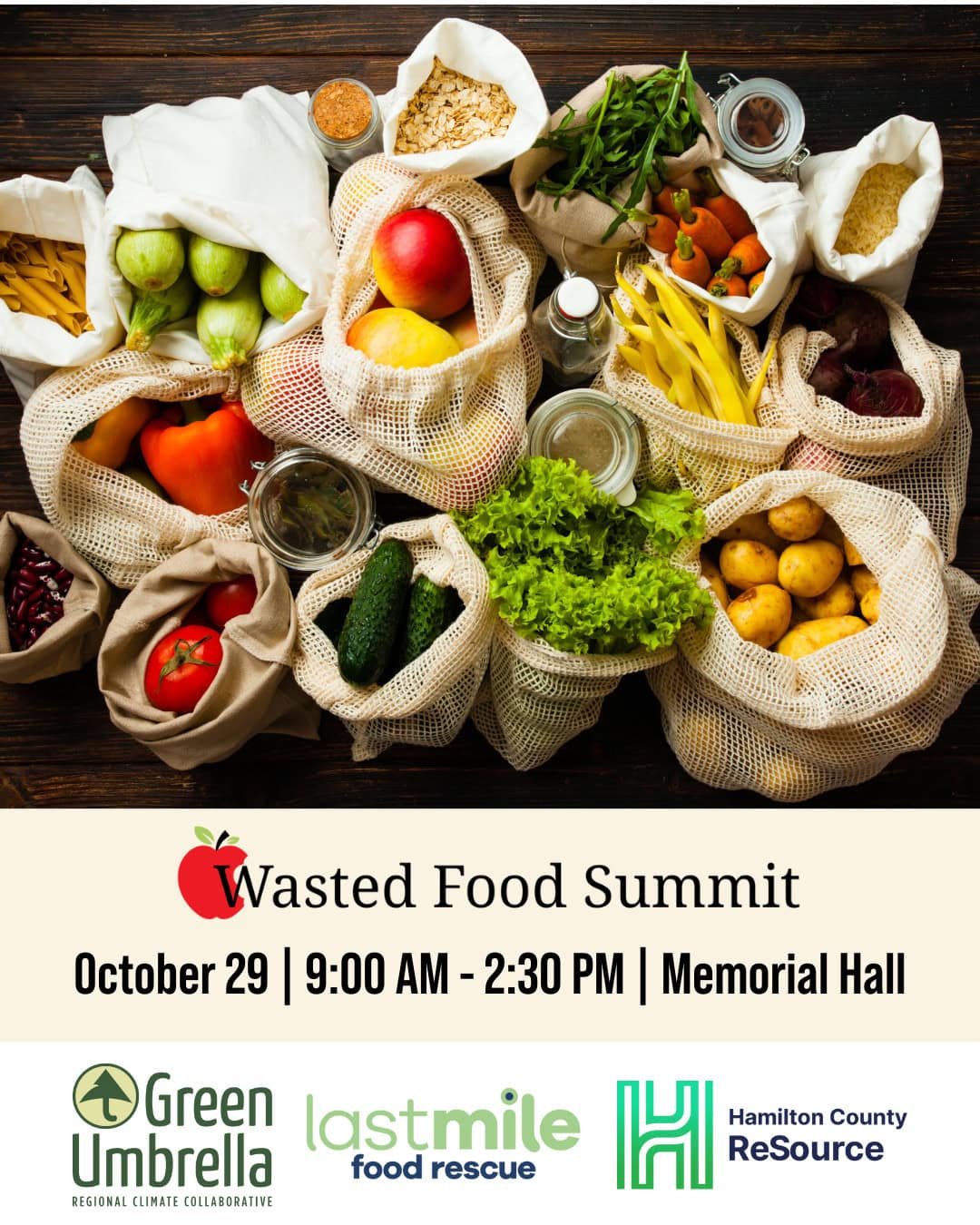
Solving a problem this big requires many hands. On October 29, 2025, the region’s first-ever Wasted Food Summit will take place at Memorial Hall in downtown Cincinnati. Co-hosted by Green Umbrella, Last Mile Food Rescue, and Hamilton County ReSource, the Wasted Food Summit will be a powerful gathering of changemakers, business leaders, chefs, advocates, and sustainability experts, all working to turn wasted food into opportunity.
Highlights from the Summit include keynotes from Sara Burnett, Executive Director of ReFED and national food waste expert, and Chef Alejandra Schrader, award-winning author, chef, food TV personality, and activist; practical steps to overcoming barriers to food donation; breakout sessions for businesses and advocates; and networking with peers and leaders in sustainability, food access, and policy.
The Wasted Food Summit is designed for businesses, institutions, and organizations, as well as individual advocates passionate about reducing waste and addressing hunger in their communities. Learn more about the Summit and register at the link here.
Funding for the Wasted Food Summit is generously provided by Sustainable Agriculture Research and Education (SARE). For questions or partnership opportunities, contact Charlie Gonzalez at charlie@greenumbrella.org.
Within Greater Cincinnati, several organizations exist to help producers, businesses, and institutions reduce wasted food. Nonprofits like Last Mile Food Rescue and LaSoupe collect surplus food. These organizations transform the food into restaurant-quality dishes and then distribute it to food insecure households and communities. (Looking to help directly? Become a volunteer food rescuer!
The average household in the United States wastes an average of 6.2 cups of food per week, or 322 cups per year – enough to fill 360 medium-sized take-out containers. Household food thrown away is often expired (according to its packaging), leftovers no one wants, or forgotten. Preventing wasted food in homes can save $1500 annually, making it very worthwhile for households to take steps in changing behavior.
Tips for wasting less food:
Even the most vigilant of food-waste vultures will create some food waste. Melon peels, egg shells, coffee grounds, and so many other items can be composted. You can set up a compost corner in your yard, or collect your scraps in a bin to compost with a local organization or at a community garden. If you compost at home, in a few months time, you can collect your own compost to use in your yard and flowerbeds!
Green Umbrella members also have access to our members-only newsletters and e-blasts. Join today to receive these perks!


By Kelly Morton
Published March 11, 2024
By Green Umbrella
Published July 6, 2026